Τετάρτη 19 Σεπτεμβρίου 2012

Sudan rejects US bid to send special forces: official


Smoke billows from the US embassy in the Sudanese capital Khartoum. By (AFP/File)
Sudan has rejected a US request to send special forces to protect its Khartoum embassy after violent protests against an American-made video mocking Islam, the official SUNA news agency said.

Sudanese Foreign Minister Ali Karti said Sudan was capable of "protecting its guests in diplomatic representations," SUNA quoted a ministry official as saying.

The United States had made the request to send special forces Friday.

US officials said Saturday that they were still monitoring the situation and that Sudan has "recommitted itself both publicly and privately to continue to protect our mission."

"We have requested additional security precautions as a result of yesterday's damage to our embassy. We are continuing to monitor the situation closely to ensure we have what we need to protect our people and facility," State Department spokeswoman Victoria Nuland said in a statement.

The Pentagon has indicated that it is examining the possibility of sending Marines to Sudan after deploying them in Yemen and Libya, where ambassador Chris Stevens was among four Americans killed in an attack on a US consulate on Tuesday.

The violence broke out during protests against an amateur Internet film produced on US soil that denigrates Islam and its Prophet Mohammed.

Τετάρτη 12 Σεπτεμβρίου 2012

WWII Special Forces – Long Range Desert Group


Ralph Bagnold formed the Special Forces Long Range Desert Group (LRDG) during WWII.  This elite group, combined with the British Special Air Service, made significant contributions, not only to World War II, but to the new direction the military would begin to explore – Special Forces.

 The LRDG Is Established
After Bagnold received approval to organize a specialized group, he received 150 volunteers from New Zealand – most with a farming background.  He felt their background would be an asset, making them more adept should vehicle maintenance and repair become necessary in the challenging environments of North Africa.


He broke the group of 150 into three smaller units.  Each unit received various armaments – including machine guns, anti-tank rifles, anti-aircraft guns, Bren guns and Thompson machine guns.  They were given wireless headsets for maintaining communication with base.  The Long Range Desert Group chose the Chevrolet 30-cwt truck for transportation and the commander for each unit was permitted to modify his vehicle if he felt it beneficial.  Each truck was capable of carrying a three week supply of food and water and had a range of 1,100 miles.
 Roles of the LRDG
One of the roles assigned to the Long Range Desert Group during the war took them to North Africa.  Here, the group was to position themselves behind enemy lines so they could scout and gather intelligence information to relay back to British military headquarters.  Their success warranted expansion and Bagnold acquired an additional 150 men from three armies – British, Indian and Rhodesian.  This World War II Special Forces group began targeting oases being held by the enemy, slipping in quickly and disappearing equally as fast, confusing the Italian commanders.

 The WWII Special Forces – Long Range Desert Group – disbanded in August of 1945, but not before leaving its mark on military history.
 

Τρίτη 11 Σεπτεμβρίου 2012

A SEAL’s Most Daring Mission


Navy SEALS are taught to practice OPSEC, elaborate operational security tactics to preserve the element of surprise in carrying out missions. Former commando Matt Bissonnette seems to have put that training to good use in the publication of his controversial tell-all book about the assault that killed Osama bin Laden. Bissonnette, who was a member of the SEAL team that snuffed out the terrorist mastermind, and his publisher went to unusual lengths to conceal the existence of the project until the publisher announced it last month.


noeasy-day-nb10-klaidman
The SEALS train hard and stay quiet. But a new tell-all by a member involved in the bin Laden raid is testing the group’s code of silence. (Clockwise fom left: no credit; Lance Iversen / San Francisco Chronicle-Corbis; Aamir Qureshi / AFP-Getty Images)

For the Pentagon it was tantamount to a sneak attack. Officials were taken by complete surprise when details of the sensational account began appearing in the media. Adding to the pressure was the fact that Bissonnette’s account of the bin Laden raid was at odds with the Obama White House’s version in some key respects, notably whether the terrorist mastermind represented a genuine threat to the commandos when they killed him. Last week officials scrambled to get a copy of the book to see whether Bissonnette’s account, No Easy Day (written under the pseudonym Mark Owen), revealed classified information. But by the time government vetters got their hands on it, thousands of copies had already been shipped to stores and the title stood atop Amazon’s sales list.

“We were caught completely off guard,” conceded one senior Pentagon official, who says national-security personnel are obligated to submit manuscripts containing sensitive information for prepublication review (Bissonnette’s lawyer says the regs merely “invite” authors to show vetters but don’t require it). Late last week, Defense Department general counsel Jeh Johnson sent a letter to Bissonnette in a last-ditch bid to minimize the damage. The threat of legal action was aimed at pressuring Bissonnette and his publisher, Dutton, to submit to the Pentagon’s demands for prepublication review. In the past, the DOD has succeeded in halting distribution of books, even in some cases pulping printed copies. But in the case of No Easy Day, it is likely too late to prevent the book from receiving wide public exposure. “At this point the onus is on the SEAL and his publisher to put the genie back in the bottle,” says one senior Pentagon official, declining to explain how that would be possible.

The Pentagon has not disclosed whether it believes No Easy Day divulges classified secrets, though one official told Newsweek “you can bet we wouldn’t have sent the letter if we didn’t think there were serious security breaches.”

Making the situation all the more awkward: the administration itself may have opened the door. The White House has drawn fire for putting out its own cinematic version of the bin Laden raid. The move rankled critics, who say it smacks of end-zone dancing and could compromise future missions. Several SEALS were motivated to back a super-PAC ad faulting Obama’s leadership. All the attention would seem at odds with the culture of the SEALS, who pride themselves on a code of omertà. But if the organization hates the spotlight, you wouldn’t know it from their recent behavior. This spring, they helped produce a wide-release movie called Act of Valor—no Oscar threat, but a good way to recruit successors to Matt Bissonnette.

Δευτέρα 10 Σεπτεμβρίου 2012

The Navy SEALS’ Dying Words

The CH-47 was shot down a year ago 


Monday, August 6 marks the first anniversary of the Afghan crash of a U.S. military CH-47 Chinook helicopter that killed 30 Americans, including 17 Navy SEALS. It was the worst single loss-of-life day for the U.S. in the war in Afghanistan. It was also the worst in the history of Naval Special Warfare.

Just six weeks before the crash, I spent several days meeting with members of the Navy’s elite SEAL Team SIX, talking to them about the loss of one of their teammates, Adam Brown, who had been killed in action during an especially complex raid on a compound in Afghanistan.

I met with two of them in a crowded bar in a remote Alaskan village. The salmon run had just begun so the place was packed with fishermen, one of whom approached our group with a tray of shot glasses overflowing with whiskey. It was also a place that SEALs would come to before heading for training exercises in the surrounding mountains.

The man offered to buy a round. “I’d be honored if we could have a drink together, to thank you all for your service. And for taking care of business in Pakistan,” he said. Tom Ratzlaff, one of the SEALs I was with, took two shots and handed one to me. “This is for Adam,” he clicked his glass against mine, I nodded, and we threw them back together.

Tom, who was better known as “Rat,” and Chris Campbell shared memories of their teammate, but as they talked about his life and the circumstances surrounding his death, they alluded to the fact that they were keenly aware death might be just around the corner, quite literally, for them too. They were about to be redeployed, and with the loss of Adam weighing heavily on their minds, there was some urgency to have a chance to talk and honor their brother-in-arms.

Kevin Houston, one of the SEALs I met with in Virginia Beach the following week acknowledged, “I could end up getting killed on my next mission I go on, but until that happens, for me, business will continue to be conducted.”

One of things I was most interested in understanding from these men was how they managed moving so fluidly between their family lives and their work as highly-trained warriors. Frequently, they were deployed, came home, and then were suddenly redeployed.

In some cases they developed rituals. Tom shared that whenever he boarded a helicopter for a mission, he said the Lord’s Prayer silently, once he got seated, and then prayed for protection. “I don’t ask for protection myself because that’s in his hands. I ask him to look after my wife and kids. Then I ask him to protect all my buddies and forgive them of all their sins and me of my sins. Then I move straight into thinking about what I’m about to do-the target, the map study, making sure I know which way’s north so I can call out things correctly on the target.”

During my interview with Heath Robinson, another teammate of Adam Brown’s, I asked “How do you do it?” referring to how they transition from lethal missions—shooting and killing people—and then coming back home, sometimes just hours later. Heath answered using his friend’s horses as an analogy. “His wife and daughter have horses,” said Heath. “Nothing makes [them] happier. Well, horses are dirty animals, every weekend he puts on his waders, goes in the barn, and shovels the manure…the dirty hay…their piss. It’s not a good job, it’s miserable, but somebody has to shovel the shit so the family can enjoy what they have.”

Kelley Brown, Adam’s wife, recalled the one time she saw “that side” of her husband. He had just returned home and was relaxing in a bubble bath when a very unlucky burglar attempted to break into their house. Adam, naked but covered in bubbles, flew out of the tub and the look in his eyes was someone she did not recognize. Moments later, the intruder bolted in fear and Adam returned to being her loving husband and the adoring father of their two young children.

The SEALs were also circumspect about death in a way that only those confronted with it regularly can be.

“I either want to die in combat, doing my job right now, or live till I’m 98 years old and see my great, great grand kids,” one of them told me. “I don’t want anything in between. None of us do. A warrior’s death, you can’t get any higher than that. It’s horrible for the family, they don’t want to hear that, but for us, the guys at our command, we’re okay with it. That is our duty, the highest calling. And if that happens to you, you hope you are in the right frame of mind that you are okay with it. I have seen a lot of people go, not well. Had they been able to do another take on it, they would probably want it to go better. I remember everything else about Adam also, but I will always remember the end. You know, your first impression lasts a relationship, and your last impression is with you forever. Adam died well.”

Six weeks after my last interview, I was returning to civilization from my version of being off the grid: camping with my family. My own happy grubby kids were in the back seat of our car when my cell phone indicated I had voicemail.

I called in and listened to one message after another and I learned that all seven of the men I had interviewed — John, Kevin, Brian, Heath, Matt, Tom, and Chris — had been killed in action the day before.

The team had been on a mission in the Wardak Province of Afghanistan, part of an operation intended to capture or kill leaders from an insurgent cell that was holed up in the region. The Chinook carrying them, along with 23 other Americans, and eight Afghan troops, had crashed and exploded after a single rocket propelled grenade struck its aft rotor blade.

Questions surrounded the crash: Why were so many from our most elite military unit on one helo? The most credible view is that it was a lucky shot, but some speculated that it might have somehow been retaliation at the same unit that had only a couple months earlier taken out Bin Laden.

As of today, some family members remain unsatisfied with the investigation. A few days after the crash, I attended Kevin Houston’s funeral, then began transcribing the interviews, haunted as I listened to their voices and read their reflections on life and on death.

As they had talked about Adam Brown, they had unknowingly defined themselves: humble, selfless, and fearless.

With the one-year anniversary of that tragedy upon us, I think of them, and their families, often.

My mind wanders to the inside of that helicopter, envisioning their final moments. It’s a dark place filled with questions — mainly the questions I didn’t ask when I interviewed each of them just weeks before they were killed — but the one thing I know for certain is that they died honorably: serving their country, doing what they believed in.

I have no doubt that they died well.


Eric Blehm is the author of FEARLESS: The Undaunted Courage and Ultimate Sacrifice of SEAL Team SIX Operator Adam Brown, which is dedicated to the memory of the men who were killed on August 6, 2011. See www.fearlessnavyseal.com

Παρασκευή 17 Αυγούστου 2012

The Makin Island Raid

Makin Island as seen from the periscope of USS Nautilus during the raid of August 17-18, 1942.
The Makin Island Raid (occurred on 17–18 August 1942) was an attack by the United States Marine Corps on Japanese military forces on Makin Island (now known as Butaritari Island) in the Pacific Ocean. The aim was to destroy Japanese installations, take prisoners, gain intelligence on the Gilbert Islands area, and divert Japanese attention and reinforcements from the Allied landings on Guadalcanal and Tulagi.

The raid was among the first American offensive ground combat operations of World War II. The force was drawn from the 2nd Raider Battalion and comprised a small battalion command group and two of the Battalion's six rifle companies. Because of space limitations aboard ship, each company embarked without one of its rifle sections. Battalion headquarters, A Company and 18 men from B Company—totaling 121 troops—were embarked aboard the submarine Argonaut and the remainder of B Company—totaling 90 men—aboard Nautilus. The raiding force was designated Task Group 7.15 (TG 7.15).

The Makin Atoll garrison consisted of the Japanese seaplane base led by Sgt. Major Kanemitsu with 73 naval air force personnel with light weapons.
 
Execution of the raid 
 
The Marines were launched in LCRLrubber boats powered by small, 6 hp(4.5 kW) outboard motors shortly after 00:00 (midnight) on 17 August. At 05:13, Companies A and B of the 2nd Raider Battalion—commanded by Lt. Col. Evans Carlson—successfully landed on Butaritari. The landing had been very difficult due to rough seas, high surf, and the failure of many of the outboard motors. Lt. Col. Carlson decided to land all his men on one beach, rather than two beaches as originally planned. At 05:15, Lt. Oscar Peatross and a 12-man squad landed on Butaritari. In the confusion of the landing, they did not get word of Carlson's decision to change plans and land all the Raiders on one beach. Thus, Peatross and his men landed where they originally planned. It turned out to be a fortunate error. Undaunted by the lack of support, Peatross led his men inland.

At 07:00, with Company A leading, the Raiders advanced from the beach across the island to its north shore before attacking southwestward. Strong resistance from Japanese snipers and machine guns stalled the advance and inflicted casualties. The Japanese then launched two banzai charges that were wiped out by the Raiders, thus killing most of the Japanese on the island. At 09:00, Lt. Peatross and his 12 men found themselves behind the Japanese who were fighting the rest of the Raiders to the east. Peatross's unit killed eight Japanese and the garrison commander Sgt. Major Kanemitsu, knocked out a machinegun and destroyed the enemy radios; but suffered three dead and two wounded. Failing to contact Carlson, they withdrew to the subs at dusk as planned.

At 13:30, 12 Japanese planes—including two flying boats—arrived over Butaritari. The flying boats—carrying reinforcements for the Japanese garrison—attempted to land in the lagoon, but were met with machinegun, rifle and Boys anti-tank rifle fire from the Raiders. One plane crashed; the other burst into flames. The remaining planes bombed and strafed but inflicted no U.S. casualties.


Σάββατο 11 Αυγούστου 2012

The History of the 10th Special Forces Group


YouTube user MH6M posted a video explaining the long and prestigious history of the 10th Special Forces Group (Airborne). Oh, you’ve never heard of them? They’re only the first ever special forces group in the US Army. No big deal. 

The origin of the unit can be traced back to the Lodge-Philbin Act of 1950, which allowed the US military to recruit foreign nationals. Half of the members of the 10SFG would be American, and the other half would be anti-communist foreign nationals. In theory, this diversity would give the group an edge if they ever needed to conduct partisan warfare behind Soviet lines. 

Luckily, the Cold War remained cold, but the 10SFG persisted as the US military’s most elite group of soldiers. They continued training both at home and abroad, exchanging unconventional combat tactics with allies such as the UK, Germany, France, Greece, Italy, Spain, and Norway. 

In the ‘60s, they saw action as they evacuated civilians from the newly-independent Congo, safely moving 239 civilians without a single casualty in just nine days. From there, individual soldiers worked alongside other special forces groups in the Vietnam War.

Budget cuts hit the military after the Vietnam War ended, but that didn’t slow down the 10SFG one bit. They continued to train abroad with NATO allies, and they deployed 17 mobile training teams to support the Lebanese Army. They’re also credited by General John Galvin as saving half a million Kurdish people from death at the hands of Saddam Hussein. 

In 1995, members of the 10SFG were among the first US soldiers to cross the border into Bosnia. Shortly after that, they provided reconnaissance and completed search-and-rescue missions for seven years in Kosovo. As you might expect, they also has a powerful presence in Iraq -- they were the first to enter Iraq prior to the invasion. Under the exceptional leadership of Col. Charles Cleveland, they executed Operation Viking Hammer, overcoming a lack of surveillance and a shortage of vehicles to accomplish the mission without a single loss of us service member. 

Are you impressed by their extensive resumé, yet? That’s barely the half of it. Watch the video for a complete run-down of this incredible special forces unit. The motto of the 10th Special Forces Group (Airborne) is simply, “The Best.” Yeah, we’d have to agree.


Παρασκευή 10 Αυγούστου 2012

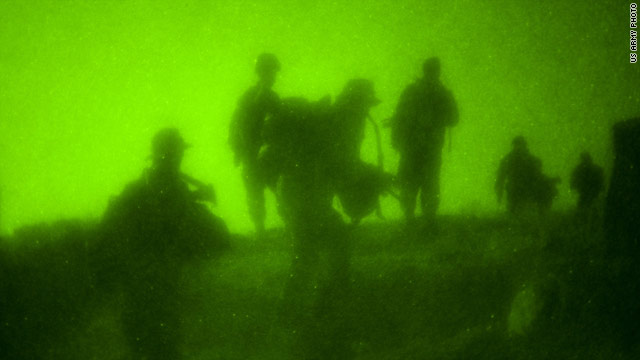
Special Operations forces risk being overused, misused, former chief says


The use of military Special Operations Forces has been a proven success in Iraq, Afghanistan and - with last year's raid on Osama bin Laden's compound - in Pakistan, but that success has some people concerned. Will the forces become the tool of choice for a president?

The former head of the U.S. Special Operations Command told the Aspen Security Forum Thursday he fears there could be a misuse of the highly trained specialists.

"It's a real danger," retired Adm. Eric Olson said. "They come to be thought of as a utility infielder, sometimes a utility infielder with guns, and they may be asked to solve problems that are not necessarily special operations problems."

Olson cited cases of Special Operations Forces being asked to provide security for individuals overseas.

The high demand has strained the elite forces. Last year, Olson warned the units were "beginning to show some fraying around the edges."

With the opposition gaining some ground in Syria in its battle to overthrow the Assad regime, some members of Congress are pressing the Obama administration to do more to help the insurgents, who are still not united or well-organized.

In a quick interview with CNN's Security Clearance on the sidelines of the security forum, Michael Sheehan, the assistant secretary of defense for special operations, said the potential use of Special Operations Forces in Syria is not a focus of his right now.

Sheehan also said there are no U.S. Special Operations Forces in Mali, where internal strife has left the northern part of the country ungoverned and where al Qaeda sympathizers have moved in, a development Sheehan called very troubling.

He said the United States is considering options, but no decisions have been made.

Special Operations Forces are at work around the world, Olson's successor, Adm. William McRaven, told CNN's Wolf Blitzer on Wednesday.


McRaven said Special Operations Forces are in 79 countries, with the largest contingent in Afghanistan. Sixty-six thousand people are part of Special Operations Command, half of them active forces. Approximately 10,000 to 12,000 are deployed at any given time, with 7,000 currently in Afghanistan and more than 3,000 elsewhere, he said.

Sheehan said the forces can operate anywhere and the numbers can range from just one or two in a country to dozens or several hundreds. The goal is to help the host nations handle their own security operations.