Εμφάνιση αναρτήσεων με ετικέτα Ειδικές Δυνάμεις. Εμφάνιση όλων των αναρτήσεων
Εμφάνιση αναρτήσεων με ετικέτα Ειδικές Δυνάμεις. Εμφάνιση όλων των αναρτήσεων
Παρασκευή 19 Απριλίου 2013


Κυριακή 2 Δεκεμβρίου 2012
Daytime Gunships Galore
The U.S. Air Force is equipping its four engine AC-130 gunships with more powerful sensors and missiles that enable these four-engine propeller driven aircraft to fly high enough (6,500 meters/20,000 feet) to avoid ground fire and operate during the day. This is a major change in the way these gunships have long operated. These gunships are owned by SOCOM (Special Operations Command) although they support all combat troops, not just the Special Forces and SEALs. While SOCOM operators prefer to operate at night, they are often out during daylight, when the presence of a gunship overhead can be a real lifesaver. This use of missiles, instead of cannon, is a recent development and the success of this technique has changed the basic design of these gunships and how they are used.
The current AC-130H gunship (nicknamed Spooky) is a 69 ton, four engine aircraft originally armed with two 20mm machine-guns, a 40mm autocannon, and a 105mm howitzer. While the aircraft can stay in the air for six hours (or more, if it refuels in the air), what really makes a difference is how well the weapons operate. Flying low (often under 10,000 feet) and at night, the gunship relies on night vision devices and well trained gunners to take out targets that are giving the troops on the ground a hard time. Four decades of continuous improvements have made the gunships increasingly lethal. But the troops have found that missiles can be just as effective as cannon fire and the AC-130 can launch missiles from higher altitudes (beyond the range of enemy anti-aircraft guns or missiles).
The recently ordered AC-130J gunships will be equipped with more powerful sensors, armed with a single 30mm autocannon, and multiple launchers for Viper Strike and SDB glide bombs, as well as Hellfire and Griffin guided missiles. Viper Strike is a 90cm (36 inch) long unpowered glider. The 130mm diameter (with the wings folded) weapon weighs 20 kg (44 pounds). Because the Viper Strike comes straight down, it is better suited for urban warfare. Its warhead weighs only 1.8 kg (four pounds) and less than half of that is explosives. This means less damage to nearby civilians but still powerful and accurate enough to destroy its target. A laser designator makes the Viper Strike accurate enough to hit an automobile or a foxhole.
The Griffin is a 15.6 kg (34.5 pound) guided missile with a 5.9 kg (13 pound) warhead which is larger than that carried by the larger (47 kg) Hellfire missile. To achieve this Griffin has a shorter range (4 kilometers), which is adequate for a gunship, which is designed to go after targets just below it, not far away.
Hellfire weighs 48.2 kg (106 pounds), carries a 9 kg (20 pound) warhead, and has a range of 8,000 meters. The 130 kg (285 pound) Small Diameter Bomb (SDB, also known as the GBU-39/B) has a shape which is more like that of a missile than a bomb (nearly two meters, as in 70 inches, long and 190mm in diameter), with the guidance system built in. The smaller blast from the SDB resulted in fewer civilian casualties. The SDB carries only 17 kg (38 pounds) of explosives and can be dropped from high altitude, using laser guidance to hit very small targets below.
Existing gunships are using all these missiles already. Equipping existing gunships to carry and fire all these missiles is neither difficult nor expensive. U.S. SOCOM (Special Operations Command) has also adopted a U.S. Marine Corps idea to provide an "instant gunship" system, which enables weapons and sensors to be quickly rolled into a C-130 transport and hooked up. This takes a few hours and turns the C-130 into a gunship armed with a 30mm autocannon and Viper Strike and Griffin missiles.
Because of their vulnerability to ground fire, the AC-130s have long only operated at night. The last time an AC-130 was lost was at Khafji, Saudi Arabia during the 1991 Persian Gulf War. The aircraft was leaving the combat zone at sunrise and was visible to Iraqi gunners in the area. But in the last two years, more and more AC-130s have been out in daylight, flying high enough to avoid hostile fire and using their powerful sensors to get a close look at what’s down there and use their missiles on anything that looks hostile.
Σάββατο 1 Δεκεμβρίου 2012
Special Operations Command Seeks Bigger Role in Conflict Prevention

U.S. special operations forces are the nation’s most celebrated terrorist killers. But they also have underutilized skills that could help prevent wars, officials said.
The war against al-Qaida and other Islamic extremist groups has become more complex since the 9/11 attacks, said Army Lt. Gen. John Mulholland, deputy commander of U.S. Special Operations Command. Navy SEAL raids and precision drone strikes alone will not be enough to defeat these enemies, he said.
“We have known for a long time that we are not going to kill our way to victory,” Mulholland said Nov. 28 at a Defense Strategies Institute conference, in Alexandria, Va.
What is needed, he said, are “preemptive efforts before the fight starts.”
Counterterrorism is “much broader than direct action,” he said. SOCOM Commander Adm. William McRaven is a strong believer in indirect methods of fighting terrorist groups, Mulholland said.
McRaven would like to see special operations forces take on a larger role in the training of foreign allies — an activity known in military-speak as “building partner capacity.” Strengthening the internal security of friendly countries where al-Qaida and its affiliates are recruiting members would help counter these groups’ influence, and possibly prevent a wider conflict, SOCOM leaders believe.
Army Special Forces, or Green Berets, have been deployed in these capacity-building roles for decades, but a more sustained effort is needed, said Mulholland. SOCOM’s skills and resources should help the United States stay “to the left of problems,” he said, instead of having to intervene later and put U.S. military forces in harm’s way.
Since McRaven took charge of SOCOM in 2011, he has sought to expand the command’s authorities in several areas, one of which is building partners’ capacity. The current process is “suboptimal,” Mulholland said, because it is rooted in the Cold War, when the world was bipolar. “We don’t believe it gives us what we need today to build capacity in areas of the world that matter,” he said. SOCOM would like more flexibility to establish long-term relationships with partners that are facing threats from al-Qaida and its affiliates, he said. “We lack the ability to deliver a program to a country that needs help. We’re looking for authorities to get at that challenge more meaningfully.”
Africa, particularly, is an area “where we should invest,” he said. Weak internal security in several African nations is raising concerns about these countries becoming safe havens for terrorist groups, Mulholland noted. A case in point is Mali, where al-Qaida's North African wing has taken over significant portions of the country.
SOCOM sees Mali as a cautionary tale. “We know what needs to be done with partners,” said Mulholland. “But we don’t have the tools.”
SOCOM’s request for broader powers to fight terrorism has stirred controversy inside the Pentagon and on Capitol Hill. It was the topic of a House Armed Services Committee emerging threats subcommittee hearing in July. Linda Robinson, a senior fellow at the Council on Foreign Relations and an expert on special operations forces, told the panel that SOCOM’s proposal had merit.
SOF units that currently are training partner militaries are “not properly resourced, organized or supported to fully maximize their potential,” she said. “Successful employment of the indirect approach requires both proactive involvement and patience for the effort to produce results.”
SOCOM officials recognize that Congress tends to be skeptical of open-ended efforts, and that their plan might be a tough sell.
“It requires placing SOF teams out in troubled regions for extended periods so they can gain familiarity, knowledge and relationships and then begin to execute solutions with the resident partners,” said Robinson. “This runs counter to a common tendency to wait until crises are full blown and action is imperative.”
She cited Colombia and The Philippines as examples of successful preemptive actions by SOF. In Colombia, more than a decade of “sustained, small footprint advisory assistance helped that country to greatly weaken the narco-terrorist insurgency known as the FARC,” Robinson said. “The Philippines is another case worthy of study to build a template for successful application of the indirect approach and achievement of enduring results.”
SOCOM’s desire for enhanced authority to deploy training teams in vulnerable countries is only one piece of a sweeping transformation that McRaven is seeking in how SOF units are employed worldwide.
The admiral raised hackles in Washington last year when he asked for direct control over the so-called theater special operations commands. TSOCs currently report to the geographic combatant commanders. But McRaven has argued that the TSOCs should be overseen directly by SOCOM to ensure they are sufficiently staffed and resourced to provide meaningful help to regional commanders.
Robinson said TSOCs have “chronically lacked adequate staff and resources” and are considered “career-ending assignments.” TSOCs should, instead, be the place where SOF skills and regional expertise should come together, said Robinson.
McRaven has proposed that TSOCs become sub-unified commands of U.S. SOCOM. He has argued that this is not a power grab by the command, but rather an attempt to better support geographic commanders. “It does create for the first time a coherent connection between TSOC and mother SOCOM,” Mulholland said. He insisted that McRaven’s plan will allow SOF to respond to crises in a timely manner. When the U.S. Consulate in Benghazi was attacked Sept. 11, a SOF company assigned to U.S. Africa Command — known as “cinc in-extremis” force — was located at the U.S. Naval Air Station in Sigonella, Italy.
“Those forces worked as advertised. They were in position,” Mulholland said. But they were physically too far from the action to be able to intervene quickly enough. Mulholland declined to discuss the particulars of the events in Benghazi but he did suggest that if SOCOM were given more discretion to move forces around based on anticipated threats, SOF quick-reaction units could be far more effective. “To be relevant in this security environment, you have to be ahead of the crisis,” he said.
If a geographic commander needs SOF assistance today, he has to submit a request for forces to the Joint Staff at the Pentagon. “That takes time,” said Mulholland. McRaven wants to be able to short-circuit that process and provide immediate help. If necessary, he would move forces horizontally from one theater to another.
Mulholland noted that only 6 percent of SOF are assigned to theaters. The majority of the 66,000-strong command is based in the United States and reports directly to SOCOM headquarters, in Tampa, Fla.
“Today McRaven doesn’t have a formal relationship with TSOCs. It’s bizarre,” Mulholland said.
McRaven’s proposed reorganization requires a revision to the Unified Command Plan. The president must approve any changes to the UCP, which was last updated in April 2011. "The current review process is still underway, but I don't have an estimate for its completion," Pentagon spokesman Lt. Col. James O. Gregory told National Defense.
“We think it’s going well,” said Mulholland. But he cautioned against counting chickens before they hatch. “We think it will be successful. COCOMs [combatant commanders] support it.”
SOCOM is seeking expanded responsibilities at a time when the command is busier and bigger than ever. With 66,000 members — including both military personnel and civilians — SOCOM has doubled since 2001. Its budget of $10.5 billion is more than twice its 2001 inflation-adjusted budget of $4.2 billion.
“SOF operators have never been held in higher regard by our nation, by the public, by our international partners and, more importantly, by our adversaries,” said Garry Reid, principal deputy assistant secretary of defense for special operations and low-intensity conflict.
SOCOM will grow to 71,000 members by 2018, Reid told the Defense Strategies Institute conference.
Reid endorsed McRaven’s plan to bolster theater-based forces. “We need to regain some regional specialization,” he said. Before 9/11, SOF were spread around the world. But during the past decade, 85 percent of SOF has been deployed in Iraq and Afghanistan, in support of U.S. Central Command. “That comes at a price,” said Reid. “We want to get back to understanding other areas and languages.”
Even as current wars wind down, the demand for SOF will no subside, said Reid. In addition to traditional SOF assignments, “there’s an increased appetite for SOF ‘liaisons’” at embassies and across U.S. and foreign government agencies, he said. “That’s a lot of 04s and 05s [field grade officers] that come out of the operational force,” said Reid. “We have a bulge of requirements.”
Κυριακή 14 Οκτωβρίου 2012
Jordan: US Forces Plan Shield Against Syria
RUSSEIFEH, Jordan -- From the edge of a steep mountain overlooking a desert compound built into an old rock quarry, machine gunfire echoes just outside hangars where U.S. special operations forces aretraining Jordanian commandos.
The Americans, who arrived in the kingdom a few weeks ago at the request of the Jordanians, are helping them develop techniques to protect civilians in case of a chemical attack from neighboring Syria, according to Jordanian officials.
On the Syrian border farther north, British military officers recently assessed the dangers of rockets constantly falling on the kingdom and ways to shield the Jordanian population and Syrian refugees as President Bashar Assad widens his military offensive against rebel enclaves in the vicinity, according to Jordan-based Western diplomats.
Jordan's King Abdullah II has repeatedly discussed plans for reinforcing security along the Syrian border and expressed concern over Syria's chemical stockpiles in meetings with visiting Western allies, according to the two diplomats, who monitor Syria from their base.
They said it is believed that Abdullah has also been shopping around for an anti-missile defense system to shield his densely populated capital, Amman -- home to nearly half of Jordan's population.
There is also talk of contingency plans for a quick pre-emptive strike if Assad loses control over his stock of chemical weapons in the civil war. The fear is that those weapons might otherwise fall into the hands of al-Qaida or Lebanon's Islamic militant group Hezbollah.
"There are dangers involved, and we have to ensure the safety of our country and the well-being of our citizens," a senior government official said in the first public Jordanian confirmation of the presence of foreign military personnel here. "We are benefiting from the experience of our allies as we prepare for the worst scenarios."
The presence of some 150 Americans at the King Abdullah II Special Operations Training Center northeast of the capital is a clear message to Assad that Jordan's longtime Western allies stand ready to defend the country if it is dragged into the 19-month Syria conflict.
Assad's regime, which is believed to have one of the world's largest chemical weapons programs, has said it might use them against external threats but not against Syrians.
But the Jordanians worry that Assad may use his chemical weapons against his neighbors, or his countrymen, if he felt that his days in power were numbered.
In May, the U.S. held joint exercises with Jordan, nicknamed the "Eager Lion," which focused on the ways to deal with a chemical weapons attack.
On Wednesday, U.S. Defense Secretary Leon Panetta said at a NATO conference of defense ministers in Brussels that the U.S. has been working with Jordan to monitor chemical and biological weapons sites in Syria and was helping Jordan deal with refugees pouring over the border.
Although the senior government official insisted that the Americans were "advisers, not troops," two senior U.S. defense officials said most were Army special operations forces. The U.S. officials spoke on condition of anonymity because they were not authorized to comment publicly about the mission.
The troops are operating out of a military center near Amman and have moved back and forth to the Syrian border. Their work involves gathering intelligence and planning joint Jordanian-U.S. military maneuvers, one U.S. official said.
The revelation of U.S. military personnel so close to the Syrian conflict suggests an escalation in theAmerican involvement, even as the Obama administration pushes back on any suggestion of a direct intervention in Syria.
The Jordanian official insisted that the kingdom was "capable of shielding itself from Syrian attack," but London-based Mideast analyst Rosemary Hollis disagreed.
"For Jordan, the more unstable Syria becomes, the deeper the crisis proceeds, the more likely Jordan will suffer from all kinds of spillover, but they are incapable of doing anything to intervene to try to turn the conflict in one direction rather than another unless they have the ballast, cover and involvement of serious international forces, which is the Americans," Hollis said.
She also saw the American military presence as a step toward possible future military operations to secure Syria's chemical stockpiles.
Torbjorn Soltvedt, a senior analyst with the Britain-based Maplecroft risk analysis group, said he saw the current situation as a "monitoring and training stage."
"Given the degree to which Syria's chemical weapons stockpiles have been dispersed across the country, an operation to secure them would be extensive and require significant numbers of troops," he said. "The Pentagon has estimated that an operation to secure Syria's chemical weapons stockpiles could require as much as 75,000 troops given the presence of several chemical agent manufacturing plants and many more storage sites throughout the country."
Panetta said that while the U.S. believes the weapons are still secure, intelligence suggests the regime might have moved some to protect them.
Steven Bucci, an expert in chemical weapons at the Heritage Foundation, has told Congress there might be as many as 50 chemical weapons sites in Syria. He said in an interview Wednesday that Syria's stockpile is potentially "like a gift from God" for militants since they don't have the know-how to assemble such weapons, while some of Syria's chemical agents are believed to have already been fitted into missile warheads.
At the desert facility, stretching 25 kilometers (16 miles) on the edge of this predominantly Palestinian suburb, Jordanian soldiers guard the walled compound, where Iraqi and Libyan special forces once received training. They refused to allow reporters in.
Jordanian officials were eager to downplay the U.S. role, concerned about the possibility of raising tensions with Syria and giving the kingdom's largely conservative population the impression that they were allowing foreigners to use Jordan as a potential launching pad for a pre-emptive attack against another Arab country.
The senior government official and two others who discussed the American military role all spoke on condition of anonymity, citing possible diplomatic sensitivities with Syria. Assad is thought to have sleeper cells scattered across the kingdom and plotting attacks on Syrian opposition and Jordanian figures.
Information Minister Sameeh Maaytah, the only official who spoke on the record, said the U.S. presence was part of "routine training exercises."
"Jordan and U.S. forces exchange visits regularly, and the presence of tens of their forces here is part of efforts to expand cooperation, exchange capabilities and protect regional stability," he said in an interview. He declined to elaborate or comment on any link to the Syrian crisis.
Amman has long had bumpy relations with Damascus because of its alliance with the United States -- Jordan's largest donor of economic and military aid -- and its 1994 peace treaty with Israel.
Jordan would like to see the Syrian regime toppled because of growing concern that Assad's key ally, Iran, is trying to spark Shiite uprisings in Arab countries ruled by members of the rival Sunni sect. Assad's ruling Alawite minority is an offshoot of Shiite Islam.
Abdullah was the first Arab leader to warn in 2004 of the sweep of Iran's "Shiite crescent," stretching from Lebanon through Syria and Iraq.
Jordanian officials have advocated a buffer zone inside the Syrian border to protect civilians fleeing bombardment. There is mounting speculation that Jordan would dispatch highly skilled special forces to secure such a zone when Assad's regime falls to prevent chaos on its border.
In the past six weeks, more than 20 Syrian rockets have fallen on Jordanian villages near the border. At least two people were wounded, including a 4-year-old Jordanian girl.
The two Western diplomats said the Britons, about a half-dozen officers specialized in intelligence gathering and special operations techniques, visited Jordan a few times over the past three months. The diplomats insisted on anonymity, saying that public comment may hamper their information gathering on Syria.
The Jordanian army already has an extensive presence on the border and has been assisting waves of Syrian refugees, who are straining the country's meager resources, mainly health care, water and utilities.
Jordan hosts some 200,000 Syrian refugees, more than any other neighboring country. Some come under constant firing from their army as they cross into the kingdom. Jordanian border guards have been wounded and a 6-year-old Syrian boy was killed in July.
Jordanian men also are moving the other way across the border, joining what intelligence officials have estimated to be about 2,000 foreigners fighting alongside Syrian rebels trying to topple Assad
Τετάρτη 3 Οκτωβρίου 2012
NIGERIAN ARMED FORCES: AIRBORNE AND SPECIAL FORCES MANEOUVRES AT THE NIGERIAN ARMY DAY CELEBRATION (NADCEL 2012)
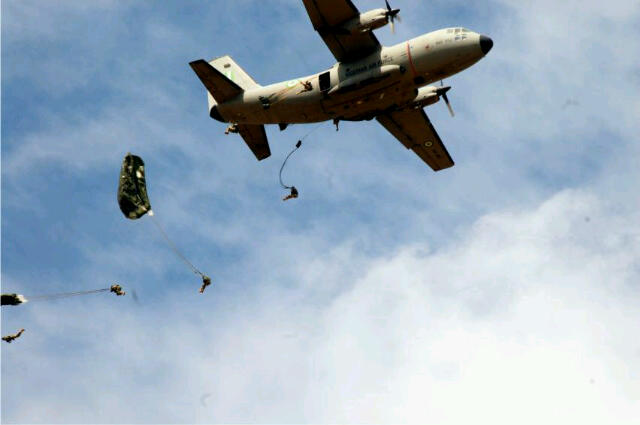
Nigerian Army paratroopers jump off an Alenia G222 plane during ‘NADCEL 2012′ at Jaji
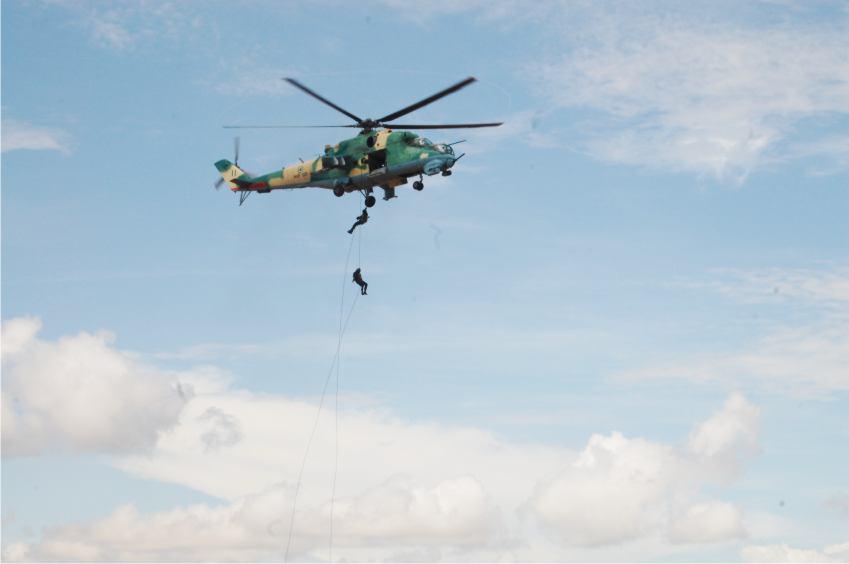
Nigerian Army Special Forces commandos rappelling off a NAF Mi-24V during ‘NADCEL 2012′ at Jaji
Τρίτη 2 Οκτωβρίου 2012
US Special Forces Deployed in Iraq, Again
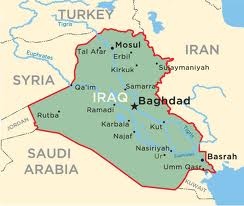
Despite the official US military withdrawal last December, American special forces “recently” returned to Iraq on a counter-terrorism mission, according to an American general in charge of weapons sales there. The mission was reported by the New York Times, in the fifteenth paragraph of a story about deepening sectarian divides.
The irony is that the US is protecting a pro-Iran Shiite regime in Baghdad against a Sunni-based insurgency while at the same time supporting a Sunni-led movement against the Iran-backed dictatorship in Syria. The Sunni rebellions are occurring in the vast Sunni region between northwestern Iraq and southern Syria where borders are porous.
During the Iraq War, many Iraqi insurgents from Anbar and Diyala provinces took sanctuary in Sunni areas of Syria. Now they are turning their weapons on two targets, the al-Malaki government in Baghdad and the Assad regime in Damascus.
The US is caught in the contradictions of proxy wars, favoring Iran’s ally in Iraq while trying to displace Iran’s proxy in Syria.
The lethal complication of the US Iraq policy is a military withdrawal that was propelled by political pressure from public opinion in the US even as the war could not be won on the battlefield. Military “redeployment”, as the scenario is described, is a general’s nightmare. In the case of Vietnam, a “decent interval” was supposedly arranged by the Nixon administration to create the appearance of an orderly American withdrawal. During the same “interval”, Nixon massively escalated his bombing campaign to no avail. Two years after the 1973 Paris peace accords, Saigon collapsed.
It is unlikely that the Maliki regime will fall to Sunni insurgents in Iraq, if only because the Sunni population is approximately twenty percent of the population. However, the return of US Special Forces is not likely to restore Iraqi stability, and they may become trapped in crossfire as the sectarian tensions deepen. The real lesson may be for Afghanistan, where another unwinnable, unaffordable war in support of an unpopular regime is stumbling towards 2014.
Κυριακή 30 Σεπτεμβρίου 2012
French Special Forces operating in Libya and Mali

The principle of military action against AQIM (al-Qaeda in the Islamic Maghreb) is now established. The capitals of countries are actively working to develop a politico-military scenario intended to rid the region of the terrorist threat. Because that is targeted by AQIM , France is at the forefront of future operation, which will be composed of the backbone forces of ECOWAS, the Economic Community of West Africa.
Bogged down in Afghanistan for over ten years, the victims of strokes plane strain their budget numbers, the French armies were warned that their participation in overseas operations now limited to a multilateral framework. The colonial past of France and the threat that weigh on the lives of the hostages if Paris was at the forefront in the Sahel also call for moderation. “We just want to have a facilitating role. No question of sending ground troops, “said a French diplomat. The Defence Minister, Jean-Yves Le Drian, promised a “logistical support” to help resolve the crisis.
French Special Forces in the region
But France is getting impatient. One hundred members of French Special Forces have been deployed in the region. They should soon be strengthened, in particular by the commandos of the French Navy. French aid also includes maritime patrol aircraft, who gather intelligence and surveillance system based in Niger. According to the hypotheses, notably in Paris, it would form an action force of a few hundred men to reconquer northern Mali, held for several months by armed Islamist groups.
A core group of 40 men, a first circle 200 to 400 men and footmen from 3000 to 4000 that men are Islamist. “This is not the Russian campaign,” says one expert dossier. “They are actually quite few. A thousand men occupies part of a state that no longer existed, “he says. The operation should not be limited to “give a kick in the anthill then go, warns an expert on the issue. Must be entered in the action duration, otherwise the problem will resurface six months later. ”
According to the daily El Khabar, an Algerian newspaper knowledgeable about security issues, the result of French Special Forces African military in Libya. “This is not information that surprises me. The French interests in the region, as Libya to Niger. Intervention but requires caution and tact due to entangling alliances uncertain actors and influence of foreign powers who have their own agenda, “said Liess Boukra, the former director of the ACSRT a Centre for the Study of Terrorism based in Algiers.
Algeria, which is to keep the pressure on terrorism outside its borders – and if possible to push towards sub-Saharan Africa – rejects any interference in the Sahel. This position does not prevent maintaining links with some ambiguous protagonists of the crisis, as the Islamist Ansar Dine Tuareg who control Kidal, one of the major cities of northern Mali. “There is something in the attitude trouble Algiers,” says a French diplomat.
Chadians in ambush
The French could be strengthened to address the shortcomings of the African Standby Force. Niger has announced its intention to provide troops and Burkina Faso and Senegal could follow. Reinforcements from Chad, a country where France has military bases could actively participate in the operation. But Chadian fighters, hardened in combat in the desert, scare their neighbors because of their reputation of soldiers uncontrollable.
For their part, Malians are divided and destroyed their army. Now, everyone knows that ECOWAS can hardly play more than a “buffer role” in this case, in the words of a diplomat. “His military capabilities are limited. ECOWAS will never be able to form the core of the intervention. ”
To support Africans, Britain has sided with France. Between the two countries’ cooperation is excellent, “says an officer. Germans and Poles have pledged support intelligence. Italians and Spaniards, their political contest. The Russians were assured that they not block the Security Council of the UN an operation in the fight against international terrorism. The Chinese seem to share this view. As for the Americans, they have offered their support, including intelligence, while denying the leading role.
Several steps are difficult to negotiate, must still be completed before the start of the operation. Acting President Traoré Dioncounda asked ECOWAS to help Mali to restore its territorial integrity. An agreement on the conditions for the deployment of an African peacekeeping force, with headquarters in Bamako, was found Sunday. If Malians refuse any deployment of foreign forces in the South, Bamako gave a discreet green light to reconquer the North. A special envoy for the Sahel will be appointed. The name of the Gabonese diplomat Jean Ping is mentioned. Its role would be to involve the African Union (AU) folder.
Source: Le Figaro
Τρίτη 25 Σεπτεμβρίου 2012
SA Special Forces speak on their work and specialised equipment

South African Special Forces are normally a very low-profile unit and are publicity-shy, but they put this aside for the Africa Aerospace and Defence 2012 exhibition, displaying boats from the seaward Special Forces application and a Hornet Rapid Deployment Reconnaissance Vehicle (RDRV) from the landward side.
Major Peet Venter described what the Special Forces Brigade does. He said the Brigade was made up of 4 Special Forces Regiment at Langebaan in the Western Cape, 5 Special Forces Regiment at Phalaborwa and the Special Forces School at Murrayhill, north of Pretoria.
He explained that the main task of Special Forces remained reconnaissance. Other tasks undertaken by the unit included support of state departments, either in Africa, VIP protection or actions associated with external deployments; support of external operations; training teams and protection elements; and anti-rhino poaching in the Kruger National Park.
Major Venter confirmed the Special Forces’ presence in Operation Copper, the anti-piracy patrol in the Mozambique Channel, but would not be drawn on details: “Most of the work that we do is training.” This included training of the South African Police Service and to a lesser extent of other state departments.
On international co-operation, Major Venter said: “I’m not aware of any training with regards to information or joining up with American Special Forces, but basically, in the whole Spec Ops environment, training goes in the same manner.”
“We do take cognisance of the things that happen in Afghanistan and Iraq and we take note of the lessons learned there, so some of the stuff influences us, but doctrine and policy and execution of operations and training is Africa-specific. The environment where we work is completely different from what they do and where they deploy.”
“We’ve taken part in exercises in Southern Africa to test the commonality of our Special Forces and those of other countries, either further north or neighbouring countries.
Major Venter introduced the Hornet RDRV, saying it was a product of Project Ambition 1A. “It’s a vehicle supplied to Special Forces for airborne use. It’s a modular concept with removable platform. This referred to a section in the back of the vehicle which could be replaced quickly for troop transport, command and control, light strike actions, or fire support to other Special Forces on the ground. One version, Major Venter said, could carry a Milan III anti-tank missile launcher.
There are three seats in the front, for a driver, a gunner and commander. The left-hand window can be lowered to carry a light machine gun (LMG) and the Hornet can carry a .50 calibre (12.7mm) heavy machine gun. Venter said the top-mounted gun could vary anywhere between a 7.62 machine gun, all the way up to a 20 mm cannon.
“There’s a full communications suite inside the vehicle as well, for instance, team communications.”
The Hornet has a basic mass in of 2 100 kg, and carries a payload of 1 200 kg.It has a Diesel Detroit VM motor and a fuel tank capacity of 100 litres
Πέμπτη 20 Σεπτεμβρίου 2012
European Helicopter Deployability is Boosted by Special Operations Exercise
The European Defence Agency’s Helicopter Training Programme is holding its latest exercise, this time in Belgium, enhancing deployability by training personnel in multinational helicopter missions, while demonstrating the advantages and concrete results of cooperation in the context of Pooling & Sharing efforts. Exercise Green Blade is focusing on helicopterspecial forces cooperation, a vital area of modern operations.
Exercise Green Blade runs from today, 17 September to 5 October 2012, hosted by the Belgian Air Component. Running together with Exercise Pegasus, a Special Operations training exercise, the two groups will work closely together on numerous missions. With helicopters from Belgium, Germany and Italy, the two exercises in total draw together some 800 personnel from seven countries: EDA Member States Belgium, Germany, Italy, Luxembourg, Austria, Ireland and Spain (as well as Canada for the Pegasus exercise).
In total 18 helicopters will deploy to Kleine Brogel Airbase, varying from transport (CH47), to utility (A109, UH-1D) and attack helicopters (A129). They will work in concert with other air assets, to maximize the realism of these testing missions, supporting assets will include an AWACS, F16, C130, and UAVs. The Belgian UAV, the B-Hunter, will be integrated for reconnaissance and surveillance of targets in direct support of the Special Forces, as well as for area surveillance during Personnel Recovery scenarios.
The exercise will principally take place in the North of Belgium, with some missions taking place over Southeast Belgium. This vast and challenging training area is characterized by a low population density, a varied geography and a favourable airspace classification.
Helicopters will execute around 65 missions of steadily increasing complexity, from typical Special Operations-related missions, such as insertion/extraction, Direct Action, Personnel Recovery, and Intelligence Surveillance & Reconnaissance, by day and by night, in single or multiship configurations. The exercise will also include more conventional types of missions, such as Airmobile Operations, Recce & Surveillance and Medical Evacuation, as well as non-tactical training missions, such as Night Vision Goggle-flying, Nap of Earth flight and Gun Firing. These missions will add up to around 650 crucial Flying Hours.
The exercise, planning for which began in June 2011, will demonstrate the benefits of cooperation in the context of Pooling & Sharing efforts, delivering an exercise that few EDA Member States could undertake alone, enhancing helicopter deployability and freeing up scarce resources for other investments in the defence sector. Peter Round, EDA Capabilities Director, explained: “We fight together, and so we have to work together, pooling our resources. An exercise like this is the best way to deliver high quality training in these challenging times.”
EDA HELICOPTER ACTIVITY
The exercise is one part of wider ongoing EDA work to boost deployability, as requested by Member States. Green Blade is the latest in a series of increasingly effective helicopter exercises, held in France, Spain, Italy and Portugal since 2009 under the Helicopter Exercise Programme. The programme has so far involved 108 helicopters. Exercise Green Blade will be the first of these exercises run by the new Core Planning Team, which will steer the programme in the longterm, incorporating lessons learned and enhancing helicopter deployability for Member States.
The EDA has also worked with its Member States to create the Helicopter Tactics Course in the UK, with 18 crews trained thus far. A new ‘train-the-trainers’ initiative is planned for this year, the European Qualified Helicopter Tactics Course, which is a joint effort by Sweden and the UK, aims to create a recognised tactics instructor cadre across Europe. Work has also started to harmonize helicopter flying training across participating Member States, trial courses have been delivered in Operational English Language learning and later this year, the EDA will conduct a capability concept demonstration into the use of distributed simulator training.
EDA AND POOLING & SHARING
The Agency’s helicopter work sits alongside a succession of EDA programmes to pool and share assets and resources, enhancing the overall military capabilities of the EDA’s Member States in challenging times for defence. Similar programmes include the Tactical Air Transport strand, which recently held a major air exercise in Zaragoza, Spain, the EDA’s work in training Counter-IED professionals, and the recently launched pilot programme to pool demand for efficient procurement. The Agency is currently working on 10 Pooling & Sharing priority areas: Countering Improvised Explosive Devices, Medical support, Intelligence, Surveillance and Reconnaissance, Helicopters, Cyber Defence, Multinational logistics support’, Common Security and Development Policy Information Exchange, Strategic & Tactical Airlift Management, and Fuel & Energy. This exercise provides an ideal opportunity to demonstrate the advances made by the EDA’s Pooling & Sharing initiative.
Τετάρτη 12 Σεπτεμβρίου 2012
WWII Special Forces – Long Range Desert Group

Ralph Bagnold formed the Special Forces Long Range Desert Group (LRDG) during WWII. This elite group, combined with the British Special Air Service, made significant contributions, not only to World War II, but to the new direction the military would begin to explore – Special Forces.
The LRDG Is Established

After Bagnold received approval to organize a specialized group, he received 150 volunteers from New Zealand – most with a farming background. He felt their background would be an asset, making them more adept should vehicle maintenance and repair become necessary in the challenging environments of North Africa.
He broke the group of 150 into three smaller units. Each unit received various armaments – including machine guns, anti-tank rifles, anti-aircraft guns, Bren guns and Thompson machine guns. They were given wireless headsets for maintaining communication with base. The Long Range Desert Group chose the Chevrolet 30-cwt truck for transportation and the commander for each unit was permitted to modify his vehicle if he felt it beneficial. Each truck was capable of carrying a three week supply of food and water and had a range of 1,100 miles.
Roles of the LRDG

One of the roles assigned to the Long Range Desert Group during the war took them to North Africa. Here, the group was to position themselves behind enemy lines so they could scout and gather intelligence information to relay back to British military headquarters. Their success warranted expansion and Bagnold acquired an additional 150 men from three armies – British, Indian and Rhodesian. This World War II Special Forces group began targeting oases being held by the enemy, slipping in quickly and disappearing equally as fast, confusing the Italian commanders.
The WWII Special Forces – Long Range Desert Group – disbanded in August of 1945, but not before leaving its mark on military history.
Τρίτη 11 Σεπτεμβρίου 2012
A SEAL’s Most Daring Mission
Navy SEALS are taught to practice OPSEC, elaborate operational security tactics to preserve the element of surprise in carrying out missions. Former commando Matt Bissonnette seems to have put that training to good use in the publication of his controversial tell-all book about the assault that killed Osama bin Laden. Bissonnette, who was a member of the SEAL team that snuffed out the terrorist mastermind, and his publisher went to unusual lengths to conceal the existence of the project until the publisher announced it last month.

For the Pentagon it was tantamount to a sneak attack. Officials were taken by complete surprise when details of the sensational account began appearing in the media. Adding to the pressure was the fact that Bissonnette’s account of the bin Laden raid was at odds with the Obama White House’s version in some key respects, notably whether the terrorist mastermind represented a genuine threat to the commandos when they killed him. Last week officials scrambled to get a copy of the book to see whether Bissonnette’s account, No Easy Day (written under the pseudonym Mark Owen), revealed classified information. But by the time government vetters got their hands on it, thousands of copies had already been shipped to stores and the title stood atop Amazon’s sales list.
“We were caught completely off guard,” conceded one senior Pentagon official, who says national-security personnel are obligated to submit manuscripts containing sensitive information for prepublication review (Bissonnette’s lawyer says the regs merely “invite” authors to show vetters but don’t require it). Late last week, Defense Department general counsel Jeh Johnson sent a letter to Bissonnette in a last-ditch bid to minimize the damage. The threat of legal action was aimed at pressuring Bissonnette and his publisher, Dutton, to submit to the Pentagon’s demands for prepublication review. In the past, the DOD has succeeded in halting distribution of books, even in some cases pulping printed copies. But in the case of No Easy Day, it is likely too late to prevent the book from receiving wide public exposure. “At this point the onus is on the SEAL and his publisher to put the genie back in the bottle,” says one senior Pentagon official, declining to explain how that would be possible.
The Pentagon has not disclosed whether it believes No Easy Day divulges classified secrets, though one official told Newsweek “you can bet we wouldn’t have sent the letter if we didn’t think there were serious security breaches.”
Making the situation all the more awkward: the administration itself may have opened the door. The White House has drawn fire for putting out its own cinematic version of the bin Laden raid. The move rankled critics, who say it smacks of end-zone dancing and could compromise future missions. Several SEALS were motivated to back a super-PAC ad faulting Obama’s leadership. All the attention would seem at odds with the culture of the SEALS, who pride themselves on a code of omertà. But if the organization hates the spotlight, you wouldn’t know it from their recent behavior. This spring, they helped produce a wide-release movie called Act of Valor—no Oscar threat, but a good way to recruit successors to Matt Bissonnette.
Δευτέρα 10 Σεπτεμβρίου 2012
The Navy SEALS’ Dying Words
 |
| The CH-47 was shot down a year ago |
Monday, August 6 marks the first anniversary of the Afghan crash of a U.S. military CH-47 Chinook helicopter that killed 30 Americans, including 17 Navy SEALS. It was the worst single loss-of-life day for the U.S. in the war in Afghanistan. It was also the worst in the history of Naval Special Warfare.
Just six weeks before the crash, I spent several days meeting with members of the Navy’s elite SEAL Team SIX, talking to them about the loss of one of their teammates, Adam Brown, who had been killed in action during an especially complex raid on a compound in Afghanistan.
I met with two of them in a crowded bar in a remote Alaskan village. The salmon run had just begun so the place was packed with fishermen, one of whom approached our group with a tray of shot glasses overflowing with whiskey. It was also a place that SEALs would come to before heading for training exercises in the surrounding mountains.
The man offered to buy a round. “I’d be honored if we could have a drink together, to thank you all for your service. And for taking care of business in Pakistan,” he said. Tom Ratzlaff, one of the SEALs I was with, took two shots and handed one to me. “This is for Adam,” he clicked his glass against mine, I nodded, and we threw them back together.
Tom, who was better known as “Rat,” and Chris Campbell shared memories of their teammate, but as they talked about his life and the circumstances surrounding his death, they alluded to the fact that they were keenly aware death might be just around the corner, quite literally, for them too. They were about to be redeployed, and with the loss of Adam weighing heavily on their minds, there was some urgency to have a chance to talk and honor their brother-in-arms.
Kevin Houston, one of the SEALs I met with in Virginia Beach the following week acknowledged, “I could end up getting killed on my next mission I go on, but until that happens, for me, business will continue to be conducted.”
One of things I was most interested in understanding from these men was how they managed moving so fluidly between their family lives and their work as highly-trained warriors. Frequently, they were deployed, came home, and then were suddenly redeployed.
In some cases they developed rituals. Tom shared that whenever he boarded a helicopter for a mission, he said the Lord’s Prayer silently, once he got seated, and then prayed for protection. “I don’t ask for protection myself because that’s in his hands. I ask him to look after my wife and kids. Then I ask him to protect all my buddies and forgive them of all their sins and me of my sins. Then I move straight into thinking about what I’m about to do-the target, the map study, making sure I know which way’s north so I can call out things correctly on the target.”
During my interview with Heath Robinson, another teammate of Adam Brown’s, I asked “How do you do it?” referring to how they transition from lethal missions—shooting and killing people—and then coming back home, sometimes just hours later. Heath answered using his friend’s horses as an analogy. “His wife and daughter have horses,” said Heath. “Nothing makes [them] happier. Well, horses are dirty animals, every weekend he puts on his waders, goes in the barn, and shovels the manure…the dirty hay…their piss. It’s not a good job, it’s miserable, but somebody has to shovel the shit so the family can enjoy what they have.”
Kelley Brown, Adam’s wife, recalled the one time she saw “that side” of her husband. He had just returned home and was relaxing in a bubble bath when a very unlucky burglar attempted to break into their house. Adam, naked but covered in bubbles, flew out of the tub and the look in his eyes was someone she did not recognize. Moments later, the intruder bolted in fear and Adam returned to being her loving husband and the adoring father of their two young children.
The SEALs were also circumspect about death in a way that only those confronted with it regularly can be.
“I either want to die in combat, doing my job right now, or live till I’m 98 years old and see my great, great grand kids,” one of them told me. “I don’t want anything in between. None of us do. A warrior’s death, you can’t get any higher than that. It’s horrible for the family, they don’t want to hear that, but for us, the guys at our command, we’re okay with it. That is our duty, the highest calling. And if that happens to you, you hope you are in the right frame of mind that you are okay with it. I have seen a lot of people go, not well. Had they been able to do another take on it, they would probably want it to go better. I remember everything else about Adam also, but I will always remember the end. You know, your first impression lasts a relationship, and your last impression is with you forever. Adam died well.”
Six weeks after my last interview, I was returning to civilization from my version of being off the grid: camping with my family. My own happy grubby kids were in the back seat of our car when my cell phone indicated I had voicemail.
I called in and listened to one message after another and I learned that all seven of the men I had interviewed — John, Kevin, Brian, Heath, Matt, Tom, and Chris — had been killed in action the day before.
The team had been on a mission in the Wardak Province of Afghanistan, part of an operation intended to capture or kill leaders from an insurgent cell that was holed up in the region. The Chinook carrying them, along with 23 other Americans, and eight Afghan troops, had crashed and exploded after a single rocket propelled grenade struck its aft rotor blade.
Questions surrounded the crash: Why were so many from our most elite military unit on one helo? The most credible view is that it was a lucky shot, but some speculated that it might have somehow been retaliation at the same unit that had only a couple months earlier taken out Bin Laden.
As of today, some family members remain unsatisfied with the investigation. A few days after the crash, I attended Kevin Houston’s funeral, then began transcribing the interviews, haunted as I listened to their voices and read their reflections on life and on death.
As they had talked about Adam Brown, they had unknowingly defined themselves: humble, selfless, and fearless.
With the one-year anniversary of that tragedy upon us, I think of them, and their families, often.
My mind wanders to the inside of that helicopter, envisioning their final moments. It’s a dark place filled with questions — mainly the questions I didn’t ask when I interviewed each of them just weeks before they were killed — but the one thing I know for certain is that they died honorably: serving their country, doing what they believed in.
I have no doubt that they died well.
Eric Blehm is the author of FEARLESS: The Undaunted Courage and Ultimate Sacrifice of SEAL Team SIX Operator Adam Brown, which is dedicated to the memory of the men who were killed on August 6, 2011. See www.fearlessnavyseal.com
Σάββατο 11 Αυγούστου 2012
The History of the 10th Special Forces Group

YouTube user MH6M posted a video explaining the long and prestigious history of the 10th Special Forces Group (Airborne). Oh, you’ve never heard of them? They’re only the first ever special forces group in the US Army. No big deal.
The origin of the unit can be traced back to the Lodge-Philbin Act of 1950, which allowed the US military to recruit foreign nationals. Half of the members of the 10SFG would be American, and the other half would be anti-communist foreign nationals. In theory, this diversity would give the group an edge if they ever needed to conduct partisan warfare behind Soviet lines.
Luckily, the Cold War remained cold, but the 10SFG persisted as the US military’s most elite group of soldiers. They continued training both at home and abroad, exchanging unconventional combat tactics with allies such as the UK, Germany, France, Greece, Italy, Spain, and Norway.
In the ‘60s, they saw action as they evacuated civilians from the newly-independent Congo, safely moving 239 civilians without a single casualty in just nine days. From there, individual soldiers worked alongside other special forces groups in the Vietnam War.
Budget cuts hit the military after the Vietnam War ended, but that didn’t slow down the 10SFG one bit. They continued to train abroad with NATO allies, and they deployed 17 mobile training teams to support the Lebanese Army. They’re also credited by General John Galvin as saving half a million Kurdish people from death at the hands of Saddam Hussein.
In 1995, members of the 10SFG were among the first US soldiers to cross the border into Bosnia. Shortly after that, they provided reconnaissance and completed search-and-rescue missions for seven years in Kosovo. As you might expect, they also has a powerful presence in Iraq -- they were the first to enter Iraq prior to the invasion. Under the exceptional leadership of Col. Charles Cleveland, they executed Operation Viking Hammer, overcoming a lack of surveillance and a shortage of vehicles to accomplish the mission without a single loss of us service member.
Are you impressed by their extensive resumé, yet? That’s barely the half of it. Watch the video for a complete run-down of this incredible special forces unit. The motto of the 10th Special Forces Group (Airborne) is simply, “The Best.” Yeah, we’d have to agree.
Παρασκευή 10 Αυγούστου 2012
Special Operations forces risk being overused, misused, former chief says
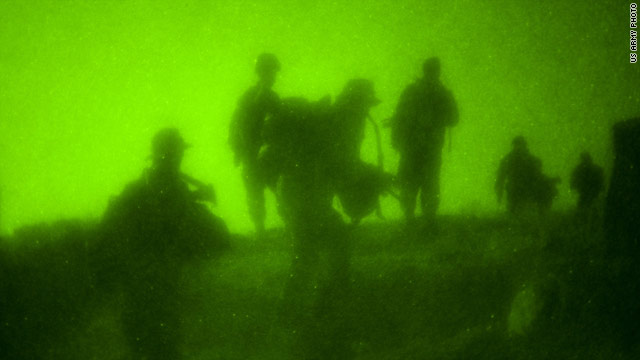
The use of military Special Operations Forces has been a proven success in Iraq, Afghanistan and - with last year's raid on Osama bin Laden's compound - in Pakistan, but that success has some people concerned. Will the forces become the tool of choice for a president?
The former head of the U.S. Special Operations Command told the Aspen Security Forum Thursday he fears there could be a misuse of the highly trained specialists.
"It's a real danger," retired Adm. Eric Olson said. "They come to be thought of as a utility infielder, sometimes a utility infielder with guns, and they may be asked to solve problems that are not necessarily special operations problems."
Olson cited cases of Special Operations Forces being asked to provide security for individuals overseas.
The high demand has strained the elite forces. Last year, Olson warned the units were "beginning to show some fraying around the edges."
With the opposition gaining some ground in Syria in its battle to overthrow the Assad regime, some members of Congress are pressing the Obama administration to do more to help the insurgents, who are still not united or well-organized.
In a quick interview with CNN's Security Clearance on the sidelines of the security forum, Michael Sheehan, the assistant secretary of defense for special operations, said the potential use of Special Operations Forces in Syria is not a focus of his right now.
Sheehan also said there are no U.S. Special Operations Forces in Mali, where internal strife has left the northern part of the country ungoverned and where al Qaeda sympathizers have moved in, a development Sheehan called very troubling.
He said the United States is considering options, but no decisions have been made.
Special Operations Forces are at work around the world, Olson's successor, Adm. William McRaven, told CNN's Wolf Blitzer on Wednesday.
McRaven said Special Operations Forces are in 79 countries, with the largest contingent in Afghanistan. Sixty-six thousand people are part of Special Operations Command, half of them active forces. Approximately 10,000 to 12,000 are deployed at any given time, with 7,000 currently in Afghanistan and more than 3,000 elsewhere, he said.
Sheehan said the forces can operate anywhere and the numbers can range from just one or two in a country to dozens or several hundreds. The goal is to help the host nations handle their own security operations.
Πέμπτη 9 Αυγούστου 2012
Stabilizing the wild southwest of Afghanistan
 |
| A Marine assigned to the 1st Marine Special Operations Battalion from Camp Pendleton works with the local Afghan Local Police in Puzeh. |
Marine special operations forces realized the security situation had changed dramatically in their stretch of the upper Sangin river valley this summer when village boys started playing policeman instead of Taliban insurgent.
Matt, leader of the team from Camp Pendleton’s 1st Marine Special Operations Battalion now stationed in Puzeh, compared it to the old days of the American West.
Back then, “it wasn’t cool to be a sheriff. It was cool to be a bank robber until Wyatt Earp came along and started making a name for himself and for lawmen. That’s kind of what we saw here,” said the team leader, who couldn’t be fully identified because of the sensitive nature of his mission. “You see kids running around now trying to play ALP (Afghan Local Police). So it’s catching on.”
Puzeh flanks a dirt road cutting through desert hills in what might be described as the wild southwest of Afghanistan. The district it’s in, Sangin, has been among the bloodiest of the war for U.S. and British forces. Yet Puzeh is the successful poster child, at the moment at least, for a unique, bottom-up approach to stabilizing the hinterlands that U.S. military commanders describe as probably their most important endeavor.
At its heart is recruitment of Afghan Local Police — villagers armed and paid to protect their hometowns — but the overarching “Village Stability Operations” spearheaded by special operations forces throughout Afghanistan have broader ambitions.
After recruiting the sons and brothers of tribal leaders to serve as local police, the special operators also aim to strengthen governance and economic development by linking them to regular police forces and local councils planning for community needs like roads or wells.
Amid the special operations forces’ more well-known missions — such as raids like the one that killed Osama bin Laden and mentoring of national security forces — the elite troops started opening “platforms” for village stability operations throughout Afghanistan about two years ago.
Lt. Col. Michael Brooks, a Camp Pendleton Marine commander in charge of Special Operations Task Force-West, said the first time he visited Puzeh early in its development, special operations forces were getting shot at by rocket-propelled grenades. The task force oversees special operators from all branches of the armed services stationed in six provinces of Afghanistan.
Several factors contributed to Puzeh’s newfound calm and the strength of its local police program, including tribal dynamics and geography, but the most important was developing strong relationships with the people, he said.
“If they’re just dealing with you and following your routine and your agenda, when you leave it’s going to revert back to what it was before you got there. But if you establish a relationship and they understand what’s going on and they see the opportunity in front of them, they truly do mobilize,” Brooks said.
The special operations forces do that by living among the Afghans, growing beards like the locals and sometimes even fasting during the day in respect for the Muslim holy month of Ramadan that started in late July.
But no matter how closely they work with the villagers, the program has little chance of success in areas where there is no connection to the central government, Brooks said. For instance, after special operations forces stepped back from one of their sites established in 2010 in Badghis province, dozens of local police surrendered last month to the Taliban.
The joint special operations command has not shied away, however, from village stability operations in the most violent areas of the country. Although the chances of success may be better when they are invited by a community, commanders said, they also have fought their way into areas appearing to be unrelenting insurgent strongholds.
One of their newest sites is in Nahr-e Saraj district — the most violent in all Afghanistan. In late June, about 800 troops, including British and U.S. infantry, tankers, engineers and both American and Afghan special operations forces, moved into the Qala-e Gaz area of the upper Gereshk valley in Nahr-e Saraj to establish a new base for village stability operations and local police. Several Marines were killed during the operation, which included the 1st Battalion, 7th Marine Regiment out of Twentynine Palms.
The idea is to eliminate irreconcilable insurgents, convince the half-hearted that there’s another way and help the Afghan government arm the rest against Taliban attacks and infiltration.
Maj. Gen. David Berger, the commanding general overseeing conventional Marine ground forces in southwestern Afghanistan, said the local police are critical to rehabilitating the country’s most war-torn areas. They are more effective at spotting signs an American might overlook, like the Pakistani sandals on a militant’s feet, he said, and they have more credibility than coalition or even Afghan national forces who usually hail from other areas of the country and don’t speak the same language as the villagers.
“What probably was a tight-woven fabric has been broken apart. Where that fabric has frayed, some of the glue is the local police. Because if the three of us are nominating our sons, we have some skin in the game,” Berger said. He cautioned, however: “It’s not a quick process. People want to wake up tomorrow and have nirvana, but it takes many months.”
New ones are still being established, but many of the existing programs are reaching maturity, commanders said, and are being transferred to Afghan control as the local police are put on the Ministry of the Interior payroll.
Critics deride the local police as militias susceptible to human rights abuses and warlordism of the kind that spawned the Taliban takeover. But Marine commanders say this approach may be the best hope for long-term peace in a country with a weak central government and strong history of tribalism.
About a year and a half after the forces moved into Puzeh, the area has about 120 local police, a functioning community council that interacts with the district, a refurbished school and a mosque under construction. Three civilians were injured by insurgent bombs in the last couple months — historically a low number for the area — and the main road is regularly trafficked and long since cleared of explosives.
Insurgents remain an active threat on the outskirts, as the memorial under construction last month in Puzeh to seven local policemen killed in action attests. But the program helping the village secure itself is virtually on auto pilot now, with U.S. special operations forces remaining on site as a quick reaction force and Afghan troops handling most recruit training to replace ones fired by local elders.
Puzeh is so calm that Matt and his Afghan counterpart, a 27-year-old special forces commander named Qurbaan, don’t wear body armor when they roll in their all-terrain vehicle out the metal gates of their compound to take the pulse and chat with villagers.
Qurbaan stands on the road wearing rubber slippers, bouncing a baby girl on his hip as he grips hands and grins and fobs off pleas for gasoline. “My daughter,” he jokes in English, with perfect political pitch.
The Puzeh local police scored two of their biggest victories this summer. In June they repelled an attack by upwards of 75 insurgents. Then in mid-July they tracked several Taliban commanders and pinned them against a cliff with gunfire until a coalition air strike finished them off.
One of the insurgents, a 30-something named Zahid easily recognized by the metal brace on his leg, had terrorized the village. After being wounded 11 times, “he had kind of taken on a boogie man persona,” said Ryan, the Marine special operations team chief.
When the Afghan local police paraded his body through town on a donkey, hundreds of people thronged the road. Afghan men approached the gates of the special operations forces compound with tears in their eyes and fired guns in celebration.
“The boogie man was dead,” Ryan said, and it wasn’t the Americans who found him. “It was Afghan Local Police.”
Εγγραφή σε:
Αναρτήσεις (Atom)