Τι είναι το TETRA;
Πρόκειται για το σύστημα ψηφιακής ασύρματης επικοινωνίας που δημιουργήθηκε προκειμένου να αντικαταστήσει όλα τα υπάρχοντα συστήματα ραδιοεπικοινωνιών VHF/UHF. Έκανε αρχικά την εμφάνιση του ως TETRA - Trans European Trunked Radio Access - Πανευρωπαϊκό Δίκτυο Κοινών Διαύλων και πριν από τρία χρόνια περίπου μετονομάστηκε σε TErrestrial Trunked RAdio, προκειμένου να επικρατήσει ως παγκόσμιο πρότυπο. Πρόκειται για το πρώτο πραγματικά ανοικτό ψηφιακό PMR (Professional Mobile Radio) Επαγγελματικό δίκτυο, που μεταξύ των άλλων προσφέρει τις εξής δυνατότητες:
1. Επικοινωνία μεταξύ συσκευών διαφορετικών κατασκευαστών.2. Δυνατότητα σύνδεσης με Η/Υ και άλλες εφαρμογές δεδομένων 3. Δυνατότητα διασύνδεσης δικτύων διαφορετικών εταιριών ή υπηρεσιών (ISI) 4. Άμεση σύνδεση μεταξύ τερματικών, πέρα από την κάλυψη του δικτύου (DMO)
Προδιαγραφές
Οι προδιαγραφές του TETRA καθορίστηκαν από το ETSI (European Telecommunications Standards Institute), σε συνεργασία με τους κατασκευαστές και τους Οργανισμούς που θα εκμεταλλευθούν τα ανάλογα δίκτυα και ψηφίστηκαν από 22 χώρες, μεταξύ των οποίων και η Ελλάδα (ΟΤΕ), στα τέλη του 1995. Πρέπει να σημειωθεί ότι τα standards του ETSI είναι υποχρεωτικά μόνο για την Ευρώπη, εφαρμόζονται όμως σε αρκετές περιπτώσεις και από χώρες εκτός της ηπείρου μας (όπως π.χ. το GSM). Το TETRA MoU δημιουργήθηκε τον Δεκέμβριο του 1994 και λειτουργεί με τρόπο ανάλογο με αυτόν του GSM Association.
Χωρητικότητα
Η χωρητικότητα του συστήματος είναι ουσιαστικά απεριόριστη, αφού επιτρέπει τη σύνδεση 16 εκατομμυρίων σταθμών σε κάθε δίκτυο και τη δημιουργία 16.000 δικτύων ανά χώρα! Το 2010 εκτιμάται ότι θα υπάρχουν 10.000.000 χρήστες TETRA σε όλο τον κόσμο. Χάρη στην τεχνολογία ΤDΜΑ που χρησιμοποιείται στο air intertace, υπάρχει δυνατότητα επικοινωνίας full duplex, χωρίς να απαιτούνται ειδικά φίλτρα ή πρόσθετα κανάλια.
Χαρακτηριστικά
Τα μεγάλα πλεονεκτήματα που προσφέρει το TETRA προορίζονται να καλύψουν τα κενά των υπηρεσιών επείγουσας ανάγκης, οι απαιτήσεις των οποίων λειτούργησαν - σε αρκετές περιπτώσεις καθοριστικά - για τη δημιουργία των προδιαγραφών. Ας δούμε όμως μερικά βασικά χαρακτηριστικά του συστήματος:
Έλεγχος χρήστη: Πριν από κάθε σύνδεση επαληθεύεται η ταυτότητα του χρήστη
Ασφάλεια: Air interface encryption, end-to-end encryption (κωδικοποίηση κατά ACELP 4.8 kbits/s). Δυνατότητα προαιρετικής χρήσης SIM για περαιτέρω κωδικούς ασφαλείας και προσωπικά data.
Επιλογή περιοχής (AS-Area Selection): Επιλογή της περιοχής εκπομπής (Τοπικό, Περιφερειακό, Εθνικό και Διεθνές Δίκτυο).
Προτεραιότητα πρόσβασης (AP-Access Priority): Σε περίπτωση συμφόρησης στο δίκτυο, γίνεται σύνδεση κατά προτεραιότητα με βάση το status του χρήστη.
Προτεραιότητα επικοινωνίας (PC- Priority Call): Τηρείται προτεραιότητα στη χρήση των διαθέσιμων πηγών του δικτύου.
Αργοπορημένη είσοδος (LE-Late Entry): Οι αργοπορημένοι (πράγμα σύνηθες για ...δημόσιες υπηρεσίες) μπορούν να συνδεθούν, ενώ μία επικοινωνία / επιχείρηση βρίσκεται ήδη σε εξέλιξη.
Υποχρεωτική διακοπή: Σε περίπτωση που ένας χρήστης υψηλής προτεραιότητας δε βρίσκει ελεύθερο συνδρομητικό κανάλι για να συνδεθεί διακόπτεται η σύνδεση ενός συνδρομητή χαμηλότερης προτεραιότητας.Παρακολούθηση επικοινωνίας: Είναι δυνατή χωρίς αναγνώριση από το χρήστη και γίνεται μόνο από το προσωπικό με άδεια καταγραφής. Παρακολούθηση συσκευής: Η εκπομπή μπορεί να ενεργοποιηθεί χωρίς ειδοποίηση του χρήστη για παρακολούθηση συμβάντων (π.χ. στην περίπτωση πειρατείας). Δυναμική ομαδοποίηση αριθμών (DGNA-Dynamic Group Number Assignment): Επιτρέπει στο λειτουργό του συστήματος να αλλάζει τov αριθμό μίας ομάδας χρηστών στιγμιαία, δίνοντας δυνατότητα ομαδοποίησης μίας επικοινωνίας σε εξέλιξη
Υπηρεσίες
Το TETRA προσφέρει ποικιλία υπηρεσιών αρκετές από τις οποίες είναι γνωστές στο ευρύ κοινό, δεδομένου ότι παρέχονται και από το GSM όπως:
It looks like GSM!
To TETRA εκτός από τις υπηρεσίες που μοιάζουν με αυτές του GSM, διαθέτει και πολλά άλλα κοινά χαρακτηριστικά όπως:
Τεχνικά Χαρακτηριστικά
Το σύστημα TETRA είναι ένα ολοκληρωμένο ψηφιακό σύστημα που παρέχει πολύ καλή ποιότητα φωνής. Εκτός από τη φωνητική επικοινωνία, υποστηρίζει μεταφορά δεδομένων και υπηρεσίες όπως Packet Data (CONP και SCNLP), με μεγάλη επιλογή ταχυτήτων μετάδοσης. Χρησιμοποιεί τεχνολογία ΤDΜΑ (Time Division Multiple Access) με τέσσερα κανάλια σε κάθε φέρον. Η απόσταση μεταξύ τους είναι 25Κz, γεγονός που σημαίνει εξαιρετική εκμετάλλευση του φάσματος συχνοτήτων.
Οικονομία επιτυγχάνεται επίσης και στους σταθμούς βάσης, όπου απαιτείται μόνο ένας πομπός για κάθε 4 συνδρομητικά κανάλια. Οι ταχύτητες μετάδοσης δεδομένων μπορούν να φτάσουν και 28.800 Bits/sec (με χρήση και των τεσσάρων καναλιών από έναν συνδρομητή / 7.2 kbps ανά κανάλι). Ανάλογα με τα κανάλια και το βαθμό προστασίας, οι ταχύτητες data διαμορφώνονται ως εξής:
Το TETRA επιτρέπει ταυτόχρονη χρήση του δικτύου σε περισσότερους από έναν οργανισμούς, προσφέροντας ασφάλεια και ανεξαρτησία σε καθέναν από αυτούς. Πρόκειται δηλαδή για ένα σύστημα υψηλών προδιαγραφών με πολύ καλή και αποδοτική χρήση των πηγών του.
Η ασφάλεια του ΤΕΤRΑ βασίζεται τόσο σε κωδικοποίηση φωνής και δεδομένων, όσο και της σηματοδοσίας και της ταυτότητας του χρήστη. Το ΤΕΤRΑ προσφέρει πολύ γρήγορο χρόνο σύνδεσης (300ms), χαρακτηριστικό ιδιαίτερα σημαντικό για τις υπηρεσίες επείγουσας ανάγκης. Κάθε κανάλι έχει ταχύτητα 9.6 kbits/sec και η φωνή κωδικοποιείται σε 4.8 kbits/sec με χρήση κωδικοποίησης ACELP (Advanced Code Excited Linear Prediction) που θεωρείται μία από τις καλύτερες μεθόδους. Το μυστικό της επιτυχίας του ΤΕΤΑΑ βρίσκεται στη διαμόρφωση που υιοθετεί π/4 - DQPSK (Digital Quadrature Phase Shift Keying), κάτι που το κάνει πολύ γρηγορότερο από όλα τα γνωστά ΤDΜΑ συστήματα. Το ΤΕΤRΑ έχει 25ΚΗz απόσταση μεταξύ των φερόντων συχνοτήτων του (λόγω της συγκεκριμένης τεχνικής), ενώ το GSM έχει 200ΚΗz, που του δίνουν τη δυνατότητα για 8 συνδρομητικά κανάλια ανά φέρον - στο ίδιο εύρος φάσματος όμως το ΤΕΤRΑ προσφέρει 230.4 kbits/sec σε σύγκριση με τα 115.2 kbits/sec του GSM. Εκτός της απευθείας σύνδεσης μεταξύ των τερματικών χωρίς χρήση του δικτύου (DMO-Direct Mode Operation), έχουν οριστεί στο ΤΕΤRΑ λειτουργίες αναμετάδοσης για επέκταση της κάλυψης των τερματικών στην απευθείας λειτουργία αλλά και λειτουργίες εξόδου (Gateway) προς άλλα δίκτυα.
Τερματικά -Συχνότητες Οι κλάσεις των τερματικών είναι: BS 0.6W, 1W, 1.6W, 2.5W, 4W, 6.3W, 10W, 15W,25W,40W MS 30W, 10W, 3W και 1W
Η εκπεμπόμενη ισχύς ρυθμίζεται αυτόματα, ανάλογα με τις κατά τόπους ανάγκες. Οι συχνότητες που χρησιμοποιούνται από το ΤΕΤRΑ είναι:
επαγγελματική χρήση:410-430 ΜΗz 450-460 / 460-470 ΜΗz 870-876 / 925-931ΜΗz υπηρεσίες επείγουσας ανάγκης: 380-400ΜΗΖ
Η χρήση των ανωτέρω συχνοτήτων έγινε δυνατή μόνο μετά την παραχώρηση από το ΝΑΤΟ 20ΜΗz (της ζώνης ραδιοφωνικών συχνοτήτων στην Ευρώπη), για να υπάρχει ομοιομορφία στις συχνότητες. Εκτιμάται ότι στην τελική φάση ανάπτυξης οι τιμές των τερματικών θα κυμανθούν 30-40% χαμηλότερα από αυτές των αντιστοίχων συσκευών για τα αναλογικά δίκτυα.
Ποιοι μπορούν να το χρησιμοποιήσουν
Αστυνομία: Αποστολή κινουμένων εικόνων, αφού με συμπίεση δεδομένων μπορούμε να στείλουμε εικόνα αποδεκτής ποιότητας χρησιμοποιώντας εύρος φάσματος μεγέθους 20kbits/sec.
Δεδομένου ότι το TETRA υποστηρίζει ταχύτητα 28,8kbitsIsec, υπερκαλύπτει τις απαιτήσεις για αποστολή εικόνας, μέσω μιας μικρής κάμερας που μπορεί να είναι ενσωματωμένη στο τερματικό.
'Ετσι μπορεί να αποσταλεί η σκηνή ενός ατυχήματος, να γίνει η αποστολή μιας εικόνας σε κάποιον αστυνομικό σε περιπολία (π.χ. για κάποιον καταζητούμενο) ή τέλος, να χρησιμοποιείται το σύστημα για έλεγχο δακτυλικών αποτυπωμάτων (μια σύλληψη π.χ. θα μπορεί να γίνεται αφού συγκριθούν τα αποτυπώματα με απλή τοποθέτηση του χεριού στο ειδικό sensor).
Σιδηρόδρομοι: Η πίεση για καλύτερη απόδοση των σιδηροδρόμων, οδήγησε στην εισαγωγή ηλεκτρονικού - σιδηροδρομικού συστήματος ελέγχου (ΕΤCS), που θα βελτιώσει το σύστημα σηματοδοσίας και θα βοηθήσει τη διεξαγωγή περισσοτέρων δρομολογίων στις περιοχές με μεγάλη κίνηση. Το ICU, το ευρωπαϊκό όργανο που ασχολείται με τα θέματα των σιδηροδρόμων, στην προσπάθειά του να λύσει το πρόβλημα, απευθύνθηκε στο GSM που μελλοντικά θα κάλυπτε τις ανάγκες με το πρόγραμμα GSM-R (Railway). Με την εισαγωγή του ΤΕΤRΑ τα πράγματα αλλάζουν, καθώς το ICU οραματίζεται ένα σύστημα που θα καλύψει τις ανάγκες του μέχρι την πιο μικρή λεπτομέρεια και αυτό γιατί υποστηρίζει κατευθείαν επικοινωνία με άλλα τερματικά, γεγονός που προσφέρει αξιοπιστία όταν το δίκτυο είναι εκτός λειτουργίας, μεγαλύτερες ταχύτητες ώστε να προλαβαίνει τις γρήγορες αλλαγές σε πολυσύχναστα μέρη, αποθήκευση εικόνας και πολλές πρόσθετες εφαρμογές, όπως υπηρεσίες ενημέρωσης ταξιδιωτών κ.ά.
Σύντομα όμως αναμένεται να αναπτυχθούν και άλλες εφαρμογές στο ΤΕΤRΑ, όπως η εύρεση θέσης οχήματος (vehicle location) με τη βοήθεια GPS, έτσι ώστε να γίνεται εντοπισμός π.χ. ενός πυροσβεστικού στο δάσος και να συντονίζεται η κίνησή του χωρίς να απαιτείται οπτική επαφή π.χ. με ελικόπτερο.
| ||||||||||||||||||||
Εμφάνιση αναρτήσεων με ετικέτα Τεχνολογία Ειδικών Επιχειρήσεων. Εμφάνιση όλων των αναρτήσεων
Εμφάνιση αναρτήσεων με ετικέτα Τεχνολογία Ειδικών Επιχειρήσεων. Εμφάνιση όλων των αναρτήσεων
Σάββατο 17 Μαΐου 2014
TETRA


Τρίτη 4 Δεκεμβρίου 2012

BAE Systems has unveiled its latest research on an advanced positioning system that exploits existing transmissions such as Wi-Fi, TV, radio and mobile phone signals, to calculate the user’s location to within a few metres.
Military platforms commonly use Global Positioning Systems (GPS) to find their position and navigate. GPS rely upon a specific and relatively weak satellite signal that is vulnerable to disruption . Known as Navigation via Signals of Opportunity (NAVSOP), BAE Systems’ new system is able to calculate its position by making use of the hundreds of different signals that are all around us.
By exploiting such a wide range of signals, NAVSOP is resistant to hostile interference such as jamming (a particular weakness of GPS) and spoofing, where a bogus signal tricks a device into misidentifying its location. The new system can learn from signals that are initially unidentified to build an ever more accurate and reliable fix on its location. Even the signals from GPS jammers can be exploited by the device to aid navigation under certain conditions.
The real beauty of NAVSOP is that the infrastructure required to make it work is already in place. There is no need to build costly networks of transmitters and the hardware behind the system is already commercially available. Another benefit is that it can be integrated into existing positioning devices to provide superior performance to GPS.
A major advantage of the system is its ability to function in places where GPS is unable to reach, such as dense urban areas and deep inside buildings. It is also able to work in the most remote parts of the world, such as the Arctic, by picking up signals that include Low-Earth-Orbit satellites and other civilian signals.
From aiding soldiers operating in remote or dense urban areas to providing improved security for Unmanned Aerial Vehicles (UAVs), which could face attempts to disrupt their guidance systems, NAVSOP has a wide range of potential military applications.
Among those pioneering this area of research is Dr Ramsey Faragher, a Principal Scientist from BAE Systems Advanced Technology Centre, who recently led a team that received a prestigious award from the Institute of Navigation for a ground-breaking paper on how aspects of the technology work indoors.
Dr Faragher said: “The potential applications of this technology are already generating huge excitement in both civilian and military circles. This research is a great example of BAE Systems working closely with potential customers to not only improve the performance of existing technology, but also tackle their weaknesses head on and find innovative ways to reduce or eliminate them.”
James Baker, Managing Director at BAE Systems Advanced Technology Centre, said: “At a time when the need to be innovative and resourceful is more important than ever, this capability represents truly outside-the-box thinking by providing a cost effective system with a wide variety of different applications. This technology is a real game changer when it comes to navigation, which builds upon the rich heritage that both BAE Systems and the UK have in radio engineering.”
This research is generating interest in both defence and civilian domains where its uses could include helping fire and rescue services find their way through smoke filled buildings and enhancing the safety of lone workers and security staff.
Source
Δευτέρα 3 Δεκεμβρίου 2012
Pelvic Protection System

The introduction of the Pelvic Protection System provides a valuable new level of protection for the dismounted soldier. Dismounted Soldiers who encountered buried mines or improvised explosive devises (IEDs) were suffering significant injuries, not only to their feet and lower legs, but to their upper thighs and groin areas. These resulted in above the knee and even high hip amputations.
“There were a lot of significant injuries, and very traumatic injuries occurring to Soldiers in the lower extremity area,” said LTC Frank Lozano, Product Manager Soldier Protective Equipment. “It’s very traumatic, very heartbreaking, when Soldiers go through those types of events, and they are very young, and then they come home and they are not able to have children.”
The Army developed the Pelvic Protection System. The system includes two layers of protection for Soldiers, including the Tier I protective under-garment, called the “PUG,” and the Tier II protective outer-garment, called the “POG.” The PUG is worn under a Soldier’s ACU pants in place of, or over the Soldier’s underwear.
It resembles typical bicycle shorts, and is made out of a breathable, moisture-wicking material on the outer thighs with a tougher Kevlar mesh to provide added protection to the inner thighs and the femoral artery. The groin also receives additional protection.
There are other benefits to wearing the PUGs. The material stops infectious debris such as dirt and manure from penetrating the skin when the Soldier is hit by an IED explosion. Even after many medical procedures some of this material can remain and cause infections that result in further amputations.
The outer garment, the POG, provides even more protection for Soldiers, and is made of ballistic material similar to the soft panels in the improved outer tactical vest (IOTV).
LTC Lozano recommends that Soldiers wear both garments. The Tier II has more ballistic protection but is a little more rigid. The undergarment is not only softer, it helps prevent the POG from chafing the Soldier.
The Army first fielded the pelvic protection system in June 2011. To date, the POGs and PUGs have been fielded to approximately 15,000 Soldiers. The typical issue includes three PUGs and one POG. Fielding is happening now for Soldiers in theater and for Soldiers stateside.
Κυριακή 2 Δεκεμβρίου 2012
Daytime Gunships Galore
The U.S. Air Force is equipping its four engine AC-130 gunships with more powerful sensors and missiles that enable these four-engine propeller driven aircraft to fly high enough (6,500 meters/20,000 feet) to avoid ground fire and operate during the day. This is a major change in the way these gunships have long operated. These gunships are owned by SOCOM (Special Operations Command) although they support all combat troops, not just the Special Forces and SEALs. While SOCOM operators prefer to operate at night, they are often out during daylight, when the presence of a gunship overhead can be a real lifesaver. This use of missiles, instead of cannon, is a recent development and the success of this technique has changed the basic design of these gunships and how they are used.
The current AC-130H gunship (nicknamed Spooky) is a 69 ton, four engine aircraft originally armed with two 20mm machine-guns, a 40mm autocannon, and a 105mm howitzer. While the aircraft can stay in the air for six hours (or more, if it refuels in the air), what really makes a difference is how well the weapons operate. Flying low (often under 10,000 feet) and at night, the gunship relies on night vision devices and well trained gunners to take out targets that are giving the troops on the ground a hard time. Four decades of continuous improvements have made the gunships increasingly lethal. But the troops have found that missiles can be just as effective as cannon fire and the AC-130 can launch missiles from higher altitudes (beyond the range of enemy anti-aircraft guns or missiles).
The recently ordered AC-130J gunships will be equipped with more powerful sensors, armed with a single 30mm autocannon, and multiple launchers for Viper Strike and SDB glide bombs, as well as Hellfire and Griffin guided missiles. Viper Strike is a 90cm (36 inch) long unpowered glider. The 130mm diameter (with the wings folded) weapon weighs 20 kg (44 pounds). Because the Viper Strike comes straight down, it is better suited for urban warfare. Its warhead weighs only 1.8 kg (four pounds) and less than half of that is explosives. This means less damage to nearby civilians but still powerful and accurate enough to destroy its target. A laser designator makes the Viper Strike accurate enough to hit an automobile or a foxhole.
The Griffin is a 15.6 kg (34.5 pound) guided missile with a 5.9 kg (13 pound) warhead which is larger than that carried by the larger (47 kg) Hellfire missile. To achieve this Griffin has a shorter range (4 kilometers), which is adequate for a gunship, which is designed to go after targets just below it, not far away.
Hellfire weighs 48.2 kg (106 pounds), carries a 9 kg (20 pound) warhead, and has a range of 8,000 meters. The 130 kg (285 pound) Small Diameter Bomb (SDB, also known as the GBU-39/B) has a shape which is more like that of a missile than a bomb (nearly two meters, as in 70 inches, long and 190mm in diameter), with the guidance system built in. The smaller blast from the SDB resulted in fewer civilian casualties. The SDB carries only 17 kg (38 pounds) of explosives and can be dropped from high altitude, using laser guidance to hit very small targets below.
Existing gunships are using all these missiles already. Equipping existing gunships to carry and fire all these missiles is neither difficult nor expensive. U.S. SOCOM (Special Operations Command) has also adopted a U.S. Marine Corps idea to provide an "instant gunship" system, which enables weapons and sensors to be quickly rolled into a C-130 transport and hooked up. This takes a few hours and turns the C-130 into a gunship armed with a 30mm autocannon and Viper Strike and Griffin missiles.
Because of their vulnerability to ground fire, the AC-130s have long only operated at night. The last time an AC-130 was lost was at Khafji, Saudi Arabia during the 1991 Persian Gulf War. The aircraft was leaving the combat zone at sunrise and was visible to Iraqi gunners in the area. But in the last two years, more and more AC-130s have been out in daylight, flying high enough to avoid hostile fire and using their powerful sensors to get a close look at what’s down there and use their missiles on anything that looks hostile.
Σάββατο 13 Οκτωβρίου 2012
Under cover, underwater: Special forces in Canada, U.S. eyeing mini-su
OTTAWA - Special forces in both Canada and the United States are taking a close look at Canadian-made mini-submarines for the murky world of covert operations.
The cutting-edge subs, some of which are built in Canada, are seen by some in the U.S. Special Forces community as essential for specialized top-secret operations against threats such as al-Qaida in coastal countries.
One defence source in Washington, who spoke on background, said the U.S. Navy has been impressed with the submarine rescue system it purchased a few years ago from B.C.-based OceanWorks International, which also sells 7.6 metre submersibles capable of carrying a handful of soldiers.
The elite, secretive U.S. Special Forces is interested and also believes the subs would "be an ideal fit" for their Canadian counterparts, said the source, who was not authorized to speak publicly.
No program has been requested or planned, however, said Brig.-Gen. Denis Thompson, the commander of Canada's special forces.
"It is an area of interest," Thompson said in an interview with The Canadian Press. "It is potentially another tool for the toolbox."
Domestic concerns and the safety of the highly trained soldiers were some of the reasons Thompson asked staff to examine the boats in the spring of last year.
Rather than operating in waters far from home, the military is concerned about missions in the three cold oceans that border Canada.
"Given the condition of the sea water that surrounds Canada, once you put a diver in the water, he really can, depending on the temperature of the water, only be effective for so long," said Thompson.
"It's all about stealth and extending the time you can leave a guy submerged — and by submerged, I mean hidden, depending on what the mission set is."
In Canada, the ultra-secret special-forces commandos known as Joint Task Force 2 have been paying particular attention to the country's coastlines.
Last year, it was revealed JTF-2 had turned to the private sector for help in early warning of possible terror threats coming from the sea. The organization tapped into an existing fisheries surveillance contract with Provincial Airlines Ltd., a subsidiary of Provincial Aerospace Ltd. of St. John’s, N.L., to monitor the movements of vessels of interest off the country's coastline.
At a rare public appearance last summer during the military's annual northern exercise, JTF-2 commandos stormed a mock "vessel of interest" at sea while the prime minister, the defence minister and the media looked on.
The subs aren't cheap: each one — some of them currently operate as underwater tour boats with up to 20 available seats — carries a price tag of $5 million.
Sea Urchin Submersibles and Nuytco Research Ltd., a subsidiary of Can-Dive Construction Ltd., are the two other Vancouver companies with underwater technology that has caught the attention of the special forces community.
Nuytco offers one-man and two-man deep sea diving suits. Can-Dive markets small diesel-electric submarines, but does not build them.
Over the last 40 years, Vancouver has become a centre of excellence in deep-diving research and technology, said a May 4, 2011 briefing note prepared for Thompson.
Note to readers: This is a corrected story. An earlier version incorrectly said the U.S. Navy had purchased a submarine-rescue system from B.C.-based International Submarine Engineering. In fact, the Vancouver company was a sub-contractor on the project, which was awarded to OceanWorks International.
Τρίτη 25 Σεπτεμβρίου 2012
SA Special Forces speak on their work and specialised equipment

South African Special Forces are normally a very low-profile unit and are publicity-shy, but they put this aside for the Africa Aerospace and Defence 2012 exhibition, displaying boats from the seaward Special Forces application and a Hornet Rapid Deployment Reconnaissance Vehicle (RDRV) from the landward side.
Major Peet Venter described what the Special Forces Brigade does. He said the Brigade was made up of 4 Special Forces Regiment at Langebaan in the Western Cape, 5 Special Forces Regiment at Phalaborwa and the Special Forces School at Murrayhill, north of Pretoria.
He explained that the main task of Special Forces remained reconnaissance. Other tasks undertaken by the unit included support of state departments, either in Africa, VIP protection or actions associated with external deployments; support of external operations; training teams and protection elements; and anti-rhino poaching in the Kruger National Park.
Major Venter confirmed the Special Forces’ presence in Operation Copper, the anti-piracy patrol in the Mozambique Channel, but would not be drawn on details: “Most of the work that we do is training.” This included training of the South African Police Service and to a lesser extent of other state departments.
On international co-operation, Major Venter said: “I’m not aware of any training with regards to information or joining up with American Special Forces, but basically, in the whole Spec Ops environment, training goes in the same manner.”
“We do take cognisance of the things that happen in Afghanistan and Iraq and we take note of the lessons learned there, so some of the stuff influences us, but doctrine and policy and execution of operations and training is Africa-specific. The environment where we work is completely different from what they do and where they deploy.”
“We’ve taken part in exercises in Southern Africa to test the commonality of our Special Forces and those of other countries, either further north or neighbouring countries.
Major Venter introduced the Hornet RDRV, saying it was a product of Project Ambition 1A. “It’s a vehicle supplied to Special Forces for airborne use. It’s a modular concept with removable platform. This referred to a section in the back of the vehicle which could be replaced quickly for troop transport, command and control, light strike actions, or fire support to other Special Forces on the ground. One version, Major Venter said, could carry a Milan III anti-tank missile launcher.
There are three seats in the front, for a driver, a gunner and commander. The left-hand window can be lowered to carry a light machine gun (LMG) and the Hornet can carry a .50 calibre (12.7mm) heavy machine gun. Venter said the top-mounted gun could vary anywhere between a 7.62 machine gun, all the way up to a 20 mm cannon.
“There’s a full communications suite inside the vehicle as well, for instance, team communications.”
The Hornet has a basic mass in of 2 100 kg, and carries a payload of 1 200 kg.It has a Diesel Detroit VM motor and a fuel tank capacity of 100 litres
Πέμπτη 20 Σεπτεμβρίου 2012
European Helicopter Deployability is Boosted by Special Operations Exercise
The European Defence Agency’s Helicopter Training Programme is holding its latest exercise, this time in Belgium, enhancing deployability by training personnel in multinational helicopter missions, while demonstrating the advantages and concrete results of cooperation in the context of Pooling & Sharing efforts. Exercise Green Blade is focusing on helicopterspecial forces cooperation, a vital area of modern operations.
Exercise Green Blade runs from today, 17 September to 5 October 2012, hosted by the Belgian Air Component. Running together with Exercise Pegasus, a Special Operations training exercise, the two groups will work closely together on numerous missions. With helicopters from Belgium, Germany and Italy, the two exercises in total draw together some 800 personnel from seven countries: EDA Member States Belgium, Germany, Italy, Luxembourg, Austria, Ireland and Spain (as well as Canada for the Pegasus exercise).
In total 18 helicopters will deploy to Kleine Brogel Airbase, varying from transport (CH47), to utility (A109, UH-1D) and attack helicopters (A129). They will work in concert with other air assets, to maximize the realism of these testing missions, supporting assets will include an AWACS, F16, C130, and UAVs. The Belgian UAV, the B-Hunter, will be integrated for reconnaissance and surveillance of targets in direct support of the Special Forces, as well as for area surveillance during Personnel Recovery scenarios.
The exercise will principally take place in the North of Belgium, with some missions taking place over Southeast Belgium. This vast and challenging training area is characterized by a low population density, a varied geography and a favourable airspace classification.
Helicopters will execute around 65 missions of steadily increasing complexity, from typical Special Operations-related missions, such as insertion/extraction, Direct Action, Personnel Recovery, and Intelligence Surveillance & Reconnaissance, by day and by night, in single or multiship configurations. The exercise will also include more conventional types of missions, such as Airmobile Operations, Recce & Surveillance and Medical Evacuation, as well as non-tactical training missions, such as Night Vision Goggle-flying, Nap of Earth flight and Gun Firing. These missions will add up to around 650 crucial Flying Hours.
The exercise, planning for which began in June 2011, will demonstrate the benefits of cooperation in the context of Pooling & Sharing efforts, delivering an exercise that few EDA Member States could undertake alone, enhancing helicopter deployability and freeing up scarce resources for other investments in the defence sector. Peter Round, EDA Capabilities Director, explained: “We fight together, and so we have to work together, pooling our resources. An exercise like this is the best way to deliver high quality training in these challenging times.”
EDA HELICOPTER ACTIVITY
The exercise is one part of wider ongoing EDA work to boost deployability, as requested by Member States. Green Blade is the latest in a series of increasingly effective helicopter exercises, held in France, Spain, Italy and Portugal since 2009 under the Helicopter Exercise Programme. The programme has so far involved 108 helicopters. Exercise Green Blade will be the first of these exercises run by the new Core Planning Team, which will steer the programme in the longterm, incorporating lessons learned and enhancing helicopter deployability for Member States.
The EDA has also worked with its Member States to create the Helicopter Tactics Course in the UK, with 18 crews trained thus far. A new ‘train-the-trainers’ initiative is planned for this year, the European Qualified Helicopter Tactics Course, which is a joint effort by Sweden and the UK, aims to create a recognised tactics instructor cadre across Europe. Work has also started to harmonize helicopter flying training across participating Member States, trial courses have been delivered in Operational English Language learning and later this year, the EDA will conduct a capability concept demonstration into the use of distributed simulator training.
EDA AND POOLING & SHARING
The Agency’s helicopter work sits alongside a succession of EDA programmes to pool and share assets and resources, enhancing the overall military capabilities of the EDA’s Member States in challenging times for defence. Similar programmes include the Tactical Air Transport strand, which recently held a major air exercise in Zaragoza, Spain, the EDA’s work in training Counter-IED professionals, and the recently launched pilot programme to pool demand for efficient procurement. The Agency is currently working on 10 Pooling & Sharing priority areas: Countering Improvised Explosive Devices, Medical support, Intelligence, Surveillance and Reconnaissance, Helicopters, Cyber Defence, Multinational logistics support’, Common Security and Development Policy Information Exchange, Strategic & Tactical Airlift Management, and Fuel & Energy. This exercise provides an ideal opportunity to demonstrate the advances made by the EDA’s Pooling & Sharing initiative.
Τρίτη 7 Αυγούστου 2012
This Is The Jeep Israeli Special Forces Would Take To The Negev Desert

"Who Dares Wins," or so goes the motto ofSayeret Matkal, one of the Israel Defense Force's special units. Israeli truck customizer AIL of Nazareth has dared with the Jeep J8-based Storm 3 Type R, and it looks like they may win... a lucrative army contract, that is.
A journo from jeepolog.com took one out for a spin in the searing heat of the Negev Desert this summer, and according to the off-duty, but very salty army guys who drove it with him, Storm 3 Type R is an ass kicker.

A stock Jeep Rubicon is already a pretty capable vehicle, but AIL had to figure out how to make it do something that the Humvees the Israeli army currently uses don't. By stuffing a 194 hp, 2.8-liter four pot turbo diesel between the fenders, they created something light and strong that has all of the offroad prowess of a Hummer without all the noise and with way better handling and maneuverability.
The only problem the old soldiers could see with Storm 3 Type R was it has a lower cargo capacity than the big AM General (although most sourcesI found showed that the HMMWV has a muchlower cargo capacity than what AIL claims the Storm 3 Type R can handle), but they said it would be a good candidate for border patrol, pursuit, and deep strike missions. And that's why the IDF has been testing them all around Israel, a country which, although it's only about the size of New Jersey, has incredibly varied terrain.
The only problem the old soldiers could see with Storm 3 Type R was it has a lower cargo capacity than the big AM General (although most sourcesI found showed that the HMMWV has a muchlower cargo capacity than what AIL claims the Storm 3 Type R can handle), but they said it would be a good candidate for border patrol, pursuit, and deep strike missions. And that's why the IDF has been testing them all around Israel, a country which, although it's only about the size of New Jersey, has incredibly varied terrain.

Storm 3 Type R's suspension is more or less stock, with an extra leaf stuffed into the shackles over a Trac-Lok Dana 44 front axle and a beefy Trac-Lok Dana 60 rear. Offroad tires are mounted on non-beadlocking steel wheels, but maybe bead locks would be advisable if the truck is deployed on terrorist chasing missions. Tipping the scales at 4,451 pounds, Storm 3 Type R can carry a 2,756-pound payload and tow 7,716 pounds.

Consensus among those who care about such things suggests that the maximum load a 6.2 V8 diesel-equipped Hummer can tow is 4,200 pounds, and that its top interior payload capacity (in certain configurations) is about the same. Plus, the four banger Jeep has a 22.5 gallon fuel tank — the Hummer, which weighs nearly 10,000 pounds empty, can hold only a few more gallons of refined black gold — so it probably has a pretty decent range.
Jeep Custom of Nazareth's creation sure looks good on paper, but we'll let the Israeli government sort that one out.
Κυριακή 5 Αυγούστου 2012
Weapons on display at Special Forces expo in Jordan
 |
Ali Jarekji / Reuters
Chinese officers check rifles of ARES Defense Systems, Inc from the U.S. at the opening of the Special Operations Forces Exhibition and Conference (SOFEX) at King Abdullah I Airbase in Amman May 8.
|
 |
Ali Jarekji / Reuters
Jordanian special forces take part in a drill during a parade at the opening of the Special Operations Forces Exhibition and Conference (SOFEX) at King Abdullah I Airbase in Amman May 8.
|

Khalil Mazraawi / AFP - Getty Images
Fire billows from explosions during a military display by Jordanian special forces at the opening of the Special Operations Forces Exhibition and Conference (SOFEX) at King Abdullah I Airbase in Amman on May 8. The exhibition showcases the latest technologies by defence manufacturers around the world.

Salah Malkawi / Getty Images
A delegation official examines a gun during the 9th Special Operations Forces Exhibition and Conference (SOFEX) May 08, 2012 in Amman, Jordan. SOFEX brings together the defense industry and government and military leaders to investigate innovations in special operations technology and tactics.
Source
Σάββατο 4 Αυγούστου 2012
Belarus Special Forces to Receive Ultralights by 2015

Belarusian special forces will be equipped with ultralight aircraft and unmanned aerial vehicles (UAV) by 2015, the Defense Ministry said on its website on Wednesday.
The forces will get T-2M-3 ultralight aircraft and Moskit and Lastochka (Swallow) aerial drones as part of a rearmament program, which also includes new special-purpose small arms and reconnaissance equipment.
The T-2M ultralight was developed by Ukraine’s Antonov Design Bureau at the end of the Cold War.
It features a cable-braced hang glider-style high-wing, weight-shift controls, a two-seats-in-side-by-side configuration open cockpit, tricycle landing gear and a single engine in pusher configuration.
The aircraft can be used for infiltration missions.
The Belarus Special Forces Command was formed on August 1, 2007 to meet the challenges of modern mobile warfare. It currently comprises several mobile brigades and a special operations brigade.
The Belarusian Special Forces have recently acquired 9A-91 compact assault rifles, VSK-94 silenced sniper rifles and OSV-96 large caliber sniper rifles, PK-AV scopes, NV/G-14 night vision goggles, laser range finders and Lesnik-3 special-purpose parachute systems.
Belarus is also developing a portable battlefield management system adapted for personal use by members of special forces units
Πέμπτη 21 Ιουνίου 2012
"Holey" bullets claimed to go faster

Competition shooters like their bullets to fly as fast (and thus straight) as possible, and they try to keep recoil to a minimum. Italian ammunition-maker CompBullet produces a series of bullets of the same name, which are claimed to both go faster than normal ammo, and produce less recoil. The secret? The bullets have go-faster holes in them.
Available in several calibers, the copper alloy bullets have a main cavity in the base, with multiple "vents" machined into their sides. These reportedly serve several purposes.
First of all, when the gun is fired, the vents supposedly allow the propellant gases to go through the sides of the bullet, providing lubrication between it and the inside of the gun's barrel.

As the bullet exits the gun, the gases symmetrically shoot sideways out of the vents. This - so we're told - creates a "muzzle brake" effect. A muzzle brake is a device fitted to the end of a gun's barrel, that redirects the gases as they leave the gun, to offset the recoil effect. The vents in the CompBullets apparently serve the same purpose.
At the same time, the gases shooting out of the vents are also said to create a rocket-like effect, increasing the bullet's velocity. All of you physicists are welcome to weigh in on this one, but it's hard to say if gases exiting the sides of a bullet would really cause it to travel any faster than gases that were limited to pushing on it from behind.
Additionally, CompBullets are claimed to produce less muzzle flash and less smoke. If nothing else, all those holes probably make them lighter than regular bullets, to boot.
Source: The Firearm Blog
Τετάρτη 20 Ιουνίου 2012
Indispensable Suppressors

That is precisely what is happening with suppresors for the multitude of weapons that warriors use every day, a technology that also makes it tougher for bad guys to determine the direction of fire aimed at them by allied troops.
SureFire LLC provides suppressors that don’t impair accuracy of firearms, Ron Canfield, public relations manager, said. The superior performance of the SureFire suppressors is a key reason that SOCOM and other armed services have decided to obtain them, he indicated
The Naval Surface Warfare Center, Crane Division—the primary solicitation center for U.S. Special Operations Command—awarded SureFire a $23.3 million contract for an indefinite quantity of sound suppressors, suppressor adapters, blank firing adapters and training adapters. The award was part of the family of muzzle brake suppressors contract, following a major suppressor evaluation by the military that focused on criteria including reliability, sound reduction, accuracy, point of impact shift, endurance/durability and operational suitability.
Other services employing SureFire suppressors include the Marine Corps, which uses their FA762SS suppressor system on every M40A5 sniper rifle, Canfield observed.
The key to SureFire suppressors, Canfield said, lies in the fast-attach technology that fastens the silencer to the weapon. Some suppressors attach with a threaded system, and if the threading isn’t precisely straight, that can mean the suppressor isn’t quite straight, affecting accuracy of each round fired, Canfield noted. The fast-attach system ensures the suppressor is mounted in precisely the same way each time, he added.
When the suppressor is mounted so it is straight, the round can avoid striking baffles, or wipes, in the silencer. And even if a round does strike a baffle in a SureFire suppressor, “it won’t deflect the bullet,” Canfield explained, because of a fail-safe feature that SureFire provides. Net result: The round will continue on to the intended target, instead of being deflected to hit something or someone nearby, such as friendly forces.
Joshua Waldron, CEO of Silencerco, said the goal of providing suppressors for every weapon may be achieved next year, thanks to aggressive moves by DoD leaders to obtain suppressors for rifles departmentwide. One key reason is that the government is sustaining staggering losses because of warfighters suffering hearing damage caused by the deafening noise of their own firearms that aren’t equipped with suppressors.
“There’s been $700 million or $800 million a year in VA benefit claims for hearing-loss damage—damage to the ear, [or] tinnitus, ringing in the ear,” Waldron noted. Because that hearing damage is unnecessary, he said, “Every ground troop should have [a suppressor] on their weapon, for more [reasons] than just hearing protection. But hearing protection, by far—it’ll pay for itself 100 times over.”
Another reason to muffle the sound of a soldier’s weapon as he fires it repeatedly is that the hearing loss caused by firearms lacking suppressors also makes post-traumatic stress syndrome more difficult to resolve, Waldron said.
“Post-traumatic stress is heightened if there’s ringing in the ear,” he explained. “These guys are coming back from the war and they’re trying to go through counseling to get back in the everyday life and get rid of their … PTSD. And they’re actually having a harder time doing that, because of the constant reminder of ringing in the ear.”
Another approach to the hearing loss problem is to provide hearing protection systems to combatants, and several companies make such systems. They typically involve ear buds, tiny sound system speakers that are worn in the ear canal, blocking out damaging noises such as the report of a warfighters’ weapon, or the deafening drone of a military vehicle on an hours-long ride toward an objective.
And some systems include micro microphones that allow combatants to hear conversations and other noises around them—including the sound of gunfire coming from an enemy sniper. Multiple mics can help to pinpoint the direction of the sound.
But Waldron challenged those systems, alleging they don’t work well. “The problem with the buds in the ear … you have no idea of the direction of the sound, because the function of the ear, and the natural design of the ear, is how you’re able to triangulate the sound.”
Without ear buds, Waldron asserted, a soldier can better determine the direction from which enemy gunfire originates. And because of that, he said, many warfighters don’t wear the ear buds they are provided.
“They usually take them right off,” he said, “because they can’t hear—they don’t understand their surroundings, their environment. Their situational awareness is completely out the window if those ear buds go in. And the really high-tech [ear buds] have microphones that compress all the sound. Those are even worse, because all of the sound comes in at the same volume. And so you have no idea of the distance or direction of the sound. So, the worst thing that you can do is to wear hearing protection if you’re a soldier.”
Without ear buds, the human ear and brain perform an intricate, instantaneous calculus to locate the origin of noises, he said. “Your brain does something really amazing,” Waldron explained. “And that is, just from experience, it catalogs the sound. You’ll actually be able to understand how far away the shot came from, whether it was 100 yards or 1,000 yards, just because of the echoes from the sonic crack going through the air, all that kind of stuff. A seasoned pro will be able to tell where the bullet’s coming from, and how far it is away, just by listening. So it’s pretty important” to have the ear able to perform its work.
If warfighters choose not to wear ear buds, then the remaining alternative for protecting their hearing is to equip their weapons with suppressors, Waldron indicated. Whatever suppressors cost, he added, that outlay is a tiny fraction of the expense of dealing with hearing loss among thousands of combatants.
That may be something that the Super Committee in Congress will have to weigh as it considers how to make hundreds of billions of dollars of cuts in defense spending: whether a cut in one area will result in far higher spending in another.
At this point, Silencerco doesn’t have a contract with the military, although some special operators—Navy SEALs—are using Silencerco suppressors, Walden said. The company is attempting to ramp up operations so it will be able to bid for military contracts, in addition to the work it is doing now to provide suppressors for government and law enforcement weapons.
“Right now, we’re a brand-new company,” he explained. “We actually formed our company in 2008, and so we have several government agencies using our suppressors. But we really haven’t gotten into the military. As of now, we’ve sent some [suppressors] to the SEALs. But that’s as far as we’ve gone. Basically, what’s happening is we started our company with a certain product to get recognition and to get clout, and we’ve been able to expand very quickly. And we haven’t actually been able to start going after those military contracts yet, because we’ve been up to a year backlogged in just providing for civilian, law enforcement and government agencies. We haven’t stepped over that threshold yet, to be able to ramp up for” military contracts. “But we’ve geared our company up to where we can start to do that very soon, and get some of those [military] contracts. We’ve been heavily developing our products for the military, and we’re going to be pushing into that field very soon.”
Waldron also said Silencerco suppressors handle gases from a bullet very well, slowing them down to the point where the bullet leaves the weapon before the gases. He also said slowing down gases means that if you are firing your weapon while in the prone position, there is no problem with gases from the shots kicking up dust and betraying your position to the enemy.
Smith Enterprise
Smith Enterprise makes suppressors that are different, John Bainer, federal support coordinator, said. The Enterprise Vortex Flash Eliminator suppressor is “100 percent maintainable by the individual soldier,” he noted. A special operator can disassemble the suppressor, clean it and reassemble it, he said. In contrast, the typical suppressor is welded permanently together, so it can’t be cleaned and carbon builds up inside—causing the sound of the weapon firing to become progressively louder.
Another positive is that in the rare instance when a Smith Enterprise suppressor has a problem, there is no need to send it back to the factory and wait for a replacement silencer to be shipped back to the military unit at half price, Bainer said. Rather, he stressed, if there is a problem, Smith will ship a rebuild kit to the unit at one-third the price of a silencer. And even that rarely happens. A unit using Smith Enterprise suppressors was in theater in Afghanistan “for a whole year, and we never got one back,” Bainer recalled.
Smith suppressors are mounted on the M4, M14, M16, the .240 machine gun, the M249 machine gun, the .30 caliber and other weapons, Bainer said. They also are in use by the Army and Navy. For example, Smith Enterprise recently was tapped to provide suppressors for special operators. Crane Naval Surface Warfare Center announced an award to Smith Enterprise of a contract for the patented Vortex Flash Eliminator. This will be a five-year, $1.5 million contract. That award came after the silencer was rated the number one suppressor in a developmental test report, according to Smith Enterprise. Crane is the testing and contracting division for the U.S. Special Operations Command.
The rigid testing performed by Crane showed that the Vortex Eliminator was superior to other models, easily passing the 95 percent flash reduction threshold through 10,000 rounds of machine gun fire, a feat extremely difficult to duplicate, according to Smith Enterprise. During the extensive level of examination the Vortex was also proven to not interfere with normal combat functions, alter weapon firing or cycling, or interfere with mechanical sight. Hazard analysis, visual flash analysis, hardness testing, drop testing, vibration testing, rust resistance testing and measurement testing were also conducted, and Smith Enterprise suppressors passed all standards, Bainer noted. The Vortex is the only flash hider with a helical flute design that breaks up the flash at multiple locations and angles in the suppressor. This contrasts with the straight flute design used by other manufacturers and allows the Vortex to reduce more flash, making troops safer in combat situations, he said.
Quicksilver Manufacturing
Quality shows when a product lasts year after year. That is the basic tenet for Quicksilver Manufacturing LLC, where Jay J. Quilligan, M.D., is the managing member. Quicksilver suppressors are being tested by special operators and other warriors.
Quilligan explained why that outlook makes Quicksilver suppressors singular gear for warfighters: Better materials yield longer life for a suppressor. “We were the first company to start using titanium alloy in the regular production of rifle suppressors,” he said. “Our first 5.56 [mm] suppressors came out in 2002. In fact some of these units I personally know are still in service, and at least one I know of has 100,000 rounds through it.”
Titanium also yields weight savings, he said. “The use of titanium has made these suppressors ultra light and long-lasting,” he explained. “The standard 5.56 unit weighs just 9.6 ounces and adds only 7.5 ounces when the flash hider is removed.”
Quicksilver as well sees superior quality in a screw-on mount. But some users want the convenience and speed of a different mount.
“We have always felt that the screw-on mount is more stable and accurate for the suppressor, and time has borne this out,” Quilligan said. But the customer must be heard. “We have, however, bowed to military and law enforcement pressure and recently released a quick-attach version that mounts directly to the A-2 birdcage flash suppressor,” he continued. “That has undergone extensive military testing and is currently being tested by special forces. It has been field tested by government also and the initial feedback was extremely positive, although they’ve not yet sent their written evaluation.”
Other Quicksilver suppressors too, are doing well in tests. “We have also recently had military field testing on our 338 magnum suppressor mounted on the 338 Extreme rifle,” he added. “Early reports are that it was extremely effective in reducing noise and that there was no muzzle flash detected.” In other testing, “We have … recently submitted for special forces testing a thread mount suppressor for the M240 machine gun and hope to hear results shortly.”
Τρίτη 19 Ιουνίου 2012
Gen II Helmet Sensor

The Gen II Helmet Sensor finally brings a screening capability to potential head and brain injuries.
When a Soldier goes through a concussive event, such as an IED explosion, he or she often does not remember exactly what happened. The event is so sudden, and the jolt so intense, that there are cases where the Soldier has walked away, thinking he was unharmed, only to learn later that he has suffered a traumatic brain injury.
The new Gen II Helmet Sensor takes away the guesswork by recording the forces that affected the Soldier during the concussive event. The helmet-mounted sensor records, measures and stores linear and rotational accelerations to the helmet. It even measures the overpressure generated by an explosive event. This information will help with regard to early detection of traumatic brain injury, and will help experts compile information that could lead to better detection and improved diagnosis of concussive events. Though the unit is not a medical device, the data it collects will be very useful to the medical community in providing treatment of traumatic brain injuries.
The Gen II sensor has a USB port for charging its battery (good for one year) and for transferring its data to a laptop computer. It weighs approximately 2.14 ounces and can store up to 1 gigabyte of data.
Κυριακή 27 Μαΐου 2012
GEN III ECWCS

The multi-layered insulating system of the Generation III Extended Cold Weather Clothing System (GEN III ECWCS) allows the wearer to adapt to varying mission requirements and environmental conditions. Materials offer a greater range of breathability and environmental protection, providing greater versatility in meeting Soldiers’ needs.
GEN III ECWCS utilizes an innovative design that reduces bulk, taking up 33 percent less space, and weighing 25 percent less than its predecessor systems. Each piece of GEN III ECWCS functions either alone or in concert with other components as a system, thus providing more options for the Soldier and enabling seamless integration with load-bearing equipment and body armor configurations. The Gen III ECWCS design allows moisture to escape and at the same time has water-resistant properties.
GEN III ECWCS is a 12-piece kit that enables the wearer to utilize seven different layers, depending on the mission and environment. The system functions through insulation, which resists the transmission of heat, traps air, and wicks moisture away from the body; layering, which increases air space and allows easy adjustment to a Soldier’s activity level; and ventilation, which allows moisture to escape. By mixing and matching Gen III ECWCS components, wearers can protect themselves from temperatures ranging from 40 degrees Fahrenheit to minus 60 degrees.
Σάββατο 26 Μαΐου 2012
Military-grade optics meet iPhone and iPad via US Night Vision and Special Operations Apps
Special Operations Forces Industry Conference (SOFIC) -- The Apple iPhone, iPad, and military-grade optics can now be seamlessly and simultaneously integrated to deliver mobile data-recording, navigation, and instant situation-analysis in a comprehensive solution to debut at this week's SOFIC, according to its developers.
Special Operations Apps/System for Optical Attachments -- also known as [SOA]2 -- can allow geo-tagging in the standard Military Grid Reference System in frame-stamped high-definition video, geo-located and accurate within seven (7) meters. The integrated smart device can be attached permanently or temporarily to optics, weapons, or equipment, according to K. Dominic Cincotti, founder of SOA and its affiliated company, MW Research and Development, Inc.
"In addition to the Apple iPhone 4S and the New iPad," Cincotti said, "we're also excited about the platforms and devices like the Windows phones, the Android, the Lumia 9000, and the Nokia PureView, with its game-changing 41-megapixel camera." He added that all of these are under consideration for [SOA]2 development, and his companies are in continuing talks with Nokia.
Generation III night vision devices, long-range day optics, infra-red imaging systems, and laser range finders, among others, can now be configured with commercially available smart devices -- including the iPhone 4S and the New iPad -- from the [SOA]2 cluster of newly patented and patent-pending hardware and software.
The Dream Team
To produce [SOA]2, Cincotti's companies led the program development with proprietary solutions, including an intellectual property cluster for attaching mobile smart devices onto weapons. Cincotti established a Joint Teaming Alliance (JTA) with US Night Vision, Hoodman USA, and Jonathan Springer, the US Army captain who created the critically acclaimed Tactical Nav App that has been soldier-deployed in the fiercest combat zones.
"This is the Dream Team for optics, US Night Vision hardware, and software, and a chance for us all to help customize the future," Cincotti said, "and with the US Army's announced intention to issue smart devices to soldiers, [SOA]2 is the best use of the newest technology and the army technology already in hand."
US Night Vision's vice president of sales and marketing, Chris Byrd, said "With [SOA]2 and USNV Hardware, warfighters can use their smart devices as a calibrated, heads-up display for optics to improve situational awareness. No longer will they have to squint through a scope and close one eye -- or be locked into goggles."
"We are taking military-grade optics and turning them into mobile high definition data-recording navigational and analysis systems," Byrd said, "while still maintaining the integrity of the original optics that have already been purchased in previous acquisition cycles."
Tactical Nav's developer, CPT Springer, said, "Bottom line up front, this joint teaming alliance is about integrating the best uses of technology we have right now and putting this technology into the hands of our combat soldiers downrange."
"The soldier already knows these mobile smart devices," CPT Springer said, "it's already in his pocket, and he's already an expert at using it."
[SOA]2 completed testing earlier this month in North Carolina, Cincotti said, and at SOFIC the Special Operations community, law enforcement, government security agencies, and major defense contractors will have the opportunity to schedule meetings for field demonstrations and to discuss inclusion in the [SOA]2 program.
"We do our best to answer and anticipate the needs of special operations," Cincotti said, "and we are looking forward to continued input from the operators and SF soldiers as [SOA]2 progresses to adoption and deployment."
Intellectual Property Cluster
[SOA]2 comprises a cluster of interlocking intellectual property, including issued patents, patents pending, and proprietary IP. SOA and MW R&D have been issued two patents already this year, executed three patent filings addressing mobile devices on weapons, and filed more than a dozen US and international patents in the last five years. US Night Vision has a patent pending, and Hoodman USA has a patent on their products.
Special Operations Apps/System for Optical Attachments [SOA]2 includes:
Multi-use Optics Case Integrator
Adapter Rings machined from Ultem 2300, which is virtually unbreakable and super-lightweight
Hoodman System Accessories, now modified for mobile devices for [SOA]2, including Day/Night Solutions to reduce glare and light bleed
A proprietary software platform that includes a range of Special Operations-specific tactical navigation apps, integrating various optics hardware and mobile-device capabilities
Future iterations of [SOA]2 now being developed by Cincotti's companies are expected to deliver Facial and Object recognition and advanced targeting, on smart phone platforms, as well as on iPads and tablets. The Tactical Nav App will feature tracking of a unit, or an individual within a unit, and a "John Madden-style" tool that allows for mark-up.
US Night Vision, founded in 2001 and located in Roseville, CA, has been providing federal, state, and local law enforcement agencies, as well as the US Military, with advanced night vision, thermal imaging, infrared and lasers. The company handles the exportation of night vision systems following U.S. Department of State, ITAR guidelines. In addition to the exclusive line of US Night Vision products, manufactured and assembled at the Roseville facility, the company is also a national distributor for L3 ETO (Electron Tube Operations), FLIR GS (Government Systems), FLIR CVS (Commercial Vision Systems), Laser Technologies, Inc., and a point of sale for L3 Warrior Systems, Laser Devices Lasers and other related optics and accessories.
Hoodman USA, founded in 1986 and headquartered in Torrance, CA, manufactures digital camera tools, including Glare Fighting LCD Loupes, Ratcheting variable angle viewers, the fastest, longest lasting CompactFlash memory cards and the world's first steel-plated, ruggedized SDHC memory card line. Hoodman has more than 500 dealers in the US and around the world.
CPT Springer, while a Battalion Fire Support Officer in Afghanistan with the 101st Airborne, began developing what would become the Tactical Nav App. He spent more than $30,000 of his own money to create the app, now available for download on the iTunes App Store.
From Bloomberg
A New Science of Stealth
January 2012's Popular Science cover story, Invisible Warriors and the New Science of Stealth, reports the two biggest new tech advances in modern camouflage, as "Camo Gets A Makeover." Popular Science (The Future Now) reported SOA's development of site-specific camouflage using an app and a mobile smart device that combines photographs of a given location into customized, terrain-specific patterns that can be digitally printed directly onto a garment or fabric. One new camo technology in the Popular Science article is simultaneous camo stealth, in which multispectral countermeasures are simultaneously deployed for manned and unmanned vehicles, equipment, hardware, and weapons, for maximum tactical advantage.
Another SOA breakthrough, the CamoScience(TM) app, was featured in CNN and NBC TV news programs last year, demonstrating the power of iPhone-like smart devices with feature-rich app attributes, including geo-positioning, augmented reality overlays, and Area of Operation HD in-camera imagery. In 2009, intellectual property created by MW R&D garnered a $43 million contract award for its licensee.
The CamoScience(TM) commercial effort is led by Cathlena Spencer, SOA chief technology officer, teaming with Apple iTunes award-winning developers of the Theodolite App, a best-selling navigation app.
For MW R&D/SOA, Dave Mullins, a veteran operator with experience on four continents, leads in-house subject matter experts, along with Mark Tocci, a veteran Ranger and a patent-pending inventor.
The Special Operations Apps/System for Optical Attachments in-house team included Sam Thompson, physicist, veteran of NASA's Mars Rover project, and a patent-pending inventor; and Ronnie Medina, veteran special forces operator and project consultant.
The Special Operations Forces Industry Conference (SOFIC) is an annual event, bringing together more than 7,000 attendees from government and industry and featuring more than 350 exhibiting companies.
Special Operations Apps is a privately held company based in Wilmington, NC, strategically situated between Fort Bragg and Camp Lejeune and convenient to Virginia Beach, VA.
"In addition to the Apple iPhone 4S and the New iPad," Cincotti said, "we're also excited about the platforms and devices like the Windows phones, the Android, the Lumia 9000, and the Nokia PureView, with its game-changing 41-megapixel camera." He added that all of these are under consideration for [SOA]2 development, and his companies are in continuing talks with Nokia.
Generation III night vision devices, long-range day optics, infra-red imaging systems, and laser range finders, among others, can now be configured with commercially available smart devices -- including the iPhone 4S and the New iPad -- from the [SOA]2 cluster of newly patented and patent-pending hardware and software.
The Dream Team
To produce [SOA]2, Cincotti's companies led the program development with proprietary solutions, including an intellectual property cluster for attaching mobile smart devices onto weapons. Cincotti established a Joint Teaming Alliance (JTA) with US Night Vision, Hoodman USA, and Jonathan Springer, the US Army captain who created the critically acclaimed Tactical Nav App that has been soldier-deployed in the fiercest combat zones.
"This is the Dream Team for optics, US Night Vision hardware, and software, and a chance for us all to help customize the future," Cincotti said, "and with the US Army's announced intention to issue smart devices to soldiers, [SOA]2 is the best use of the newest technology and the army technology already in hand."
US Night Vision's vice president of sales and marketing, Chris Byrd, said "With [SOA]2 and USNV Hardware, warfighters can use their smart devices as a calibrated, heads-up display for optics to improve situational awareness. No longer will they have to squint through a scope and close one eye -- or be locked into goggles."
"We are taking military-grade optics and turning them into mobile high definition data-recording navigational and analysis systems," Byrd said, "while still maintaining the integrity of the original optics that have already been purchased in previous acquisition cycles."
Tactical Nav's developer, CPT Springer, said, "Bottom line up front, this joint teaming alliance is about integrating the best uses of technology we have right now and putting this technology into the hands of our combat soldiers downrange."
"The soldier already knows these mobile smart devices," CPT Springer said, "it's already in his pocket, and he's already an expert at using it."
[SOA]2 completed testing earlier this month in North Carolina, Cincotti said, and at SOFIC the Special Operations community, law enforcement, government security agencies, and major defense contractors will have the opportunity to schedule meetings for field demonstrations and to discuss inclusion in the [SOA]2 program.
"We do our best to answer and anticipate the needs of special operations," Cincotti said, "and we are looking forward to continued input from the operators and SF soldiers as [SOA]2 progresses to adoption and deployment."
Intellectual Property Cluster
[SOA]2 comprises a cluster of interlocking intellectual property, including issued patents, patents pending, and proprietary IP. SOA and MW R&D have been issued two patents already this year, executed three patent filings addressing mobile devices on weapons, and filed more than a dozen US and international patents in the last five years. US Night Vision has a patent pending, and Hoodman USA has a patent on their products.
Special Operations Apps/System for Optical Attachments [SOA]2 includes:
Multi-use Optics Case Integrator
Adapter Rings machined from Ultem 2300, which is virtually unbreakable and super-lightweight
Hoodman System Accessories, now modified for mobile devices for [SOA]2, including Day/Night Solutions to reduce glare and light bleed
A proprietary software platform that includes a range of Special Operations-specific tactical navigation apps, integrating various optics hardware and mobile-device capabilities
Future iterations of [SOA]2 now being developed by Cincotti's companies are expected to deliver Facial and Object recognition and advanced targeting, on smart phone platforms, as well as on iPads and tablets. The Tactical Nav App will feature tracking of a unit, or an individual within a unit, and a "John Madden-style" tool that allows for mark-up.
US Night Vision, founded in 2001 and located in Roseville, CA, has been providing federal, state, and local law enforcement agencies, as well as the US Military, with advanced night vision, thermal imaging, infrared and lasers. The company handles the exportation of night vision systems following U.S. Department of State, ITAR guidelines. In addition to the exclusive line of US Night Vision products, manufactured and assembled at the Roseville facility, the company is also a national distributor for L3 ETO (Electron Tube Operations), FLIR GS (Government Systems), FLIR CVS (Commercial Vision Systems), Laser Technologies, Inc., and a point of sale for L3 Warrior Systems, Laser Devices Lasers and other related optics and accessories.
Hoodman USA, founded in 1986 and headquartered in Torrance, CA, manufactures digital camera tools, including Glare Fighting LCD Loupes, Ratcheting variable angle viewers, the fastest, longest lasting CompactFlash memory cards and the world's first steel-plated, ruggedized SDHC memory card line. Hoodman has more than 500 dealers in the US and around the world.
CPT Springer, while a Battalion Fire Support Officer in Afghanistan with the 101st Airborne, began developing what would become the Tactical Nav App. He spent more than $30,000 of his own money to create the app, now available for download on the iTunes App Store.
From Bloomberg
A New Science of Stealth
January 2012's Popular Science cover story, Invisible Warriors and the New Science of Stealth, reports the two biggest new tech advances in modern camouflage, as "Camo Gets A Makeover." Popular Science (The Future Now) reported SOA's development of site-specific camouflage using an app and a mobile smart device that combines photographs of a given location into customized, terrain-specific patterns that can be digitally printed directly onto a garment or fabric. One new camo technology in the Popular Science article is simultaneous camo stealth, in which multispectral countermeasures are simultaneously deployed for manned and unmanned vehicles, equipment, hardware, and weapons, for maximum tactical advantage.
Another SOA breakthrough, the CamoScience(TM) app, was featured in CNN and NBC TV news programs last year, demonstrating the power of iPhone-like smart devices with feature-rich app attributes, including geo-positioning, augmented reality overlays, and Area of Operation HD in-camera imagery. In 2009, intellectual property created by MW R&D garnered a $43 million contract award for its licensee.
The CamoScience(TM) commercial effort is led by Cathlena Spencer, SOA chief technology officer, teaming with Apple iTunes award-winning developers of the Theodolite App, a best-selling navigation app.
For MW R&D/SOA, Dave Mullins, a veteran operator with experience on four continents, leads in-house subject matter experts, along with Mark Tocci, a veteran Ranger and a patent-pending inventor.
The Special Operations Apps/System for Optical Attachments in-house team included Sam Thompson, physicist, veteran of NASA's Mars Rover project, and a patent-pending inventor; and Ronnie Medina, veteran special forces operator and project consultant.
The Special Operations Forces Industry Conference (SOFIC) is an annual event, bringing together more than 7,000 attendees from government and industry and featuring more than 350 exhibiting companies.
Special Operations Apps is a privately held company based in Wilmington, NC, strategically situated between Fort Bragg and Camp Lejeune and convenient to Virginia Beach, VA.
Τρίτη 8 Μαΐου 2012
Oshkosh Defense Showcases Special Forces Vehicle Expertise at SOFEX 2012
Special forces worldwide need highly mobile tactical vehicles that meet the requirements of their unique mission profiles. Oshkosh Defense, a division of Oshkosh Corporation (NYSE:OSK), will be displaying two such vehicles at the Special Operations Forces Exhibition & Conference (SOFEX) in Amman, Jordan, May 7-10. The Oshkosh MRAP All-Terrain Vehicle (M-ATV) Special Forces Vehicle (SFV) and SandCat Tactical Protector Vehicle (TPV) will be in Oshkosh booth B650.
“The M-ATV SFV and SandCat TPV are protected and highly mobile vehicles that can support a wide array of demanding law enforcement, border patrol and special forces missions,” said Serge Buchakjian, senior vice president and general manager of International Programs for Oshkosh Defense. “Our experience providing special forces vehicles is matched by our dedication to provide full life-cycle sustainment and support services to every truck, regardless of location. We have established offices and networks in the Middle East to provide customers with support from individuals who understand the challenges unique to the region.”
Oshkosh has more than 90 years of experience designing, manufacturing and sustaining world-class vehicles for governments, militaries and special forces units around the world. Oshkosh Defense uses a collaborative, integrated approach to meet customers’ needs, from vehicle design and production to training and aftermarket sustainment. The company has produced more than 100,000 military-class trucks and trailers, and Oshkosh vehicles have been proven in severe off-road environments.
Oshkosh’s aftermarket solutions cover the complete spectrum of vehicle life-cycle support, including training services, instruction manuals, maintenance and repairs, parts supply and fleet restoration services. Oshkosh Field Service Representatives (FSR) travel globally to ensure vehicles and personnel are at peak operational readiness. The company’s robust operator and maintenance training services provide systems-level expertise on the platforms and technologies they support, and Oshkosh’s parts-supply network is available 24/7 to provide instant access to spare and repair parts for all vehicle makes and models.
Oshkosh Defense has locations around the world, including its Oshkosh Arabia headquarters in Dubai, United Arab Emirates.
VEHICLES ON DISPLAY
The SFV variant is part of the M-ATV family of vehicles, which is designed to support the most challenging tactical operations in rugged and mountainous off-road terrain. The proven vehicle combines best-in-class off-road mobility and high levels of protection. The M-ATV SFV features alterations specific to the needs of special forces, including a modified cargo deck, intended to accept specialized equipment based on each mission’s requirements, and larger front windscreens for increased visibility. Oshkosh has received awards to date for nearly 8,700 M-ATVs, including more than 460 SFV variants, as well as spare parts kits, upgrade kits and aftermarket support.
The SandCat TPV is part of the Oshkosh SandCat family of vehicles and can be configured to meet individual performance, protection and payload needs. The vehicle’s armor system can be customized based on the threat level and mission profile, and seating capacity can be adjusted to accommodate up to nine passengers. The vehicle also can be equipped with standard or customized storage, and is typically integrated with a wide array of weapons and communications systems. The SandCat TPV’s compact design, combined with a 45.7 centimeter vertical step capability and 12.7 meter curb-to-curb turning circle, enables mobility in both tight urban settings and rugged rural landscapes. Oshkosh has received orders for the SandCat from Mexico, the United States, Sweden, Bulgaria, Canada and Nigeria.
Oshkosh Defense leadership will be available at SOFEX to discuss the company’s full range of vehicle and service offerings at booth B650.
Σάββατο 5 Μαΐου 2012
Taiwan Special forces receive new light combat vehicl
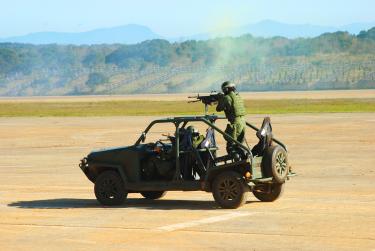 |
Taiwan’s new Special Combat and Assault Vehicle is shown in this undated picture taken at an undisclosed location |
The Ministry of Taiwan National Defense has begun delivering a new indigenous light combat vehicle to be used by special forces for off-road combat operations.
The unarmored, 1,225kg four-wheel-drive Special Combat and Assault Vehicle (SC-09A) was locally manufactured, with an initial contract for 56 vehicles, Defense News reported yesterday, adding that a ministry source would not reveal the identity of the manufacturer.
The 871 Airborne Group under Special Forces Command is the first unit to receive the three-seat vehicle, which comes with puncture-proof wheels, an anti-blast fuel tank, night-vision equipment and a searchlight, the article said. The vehicle has right passenger and rear gun mounts that can be fitted with MK-19 40mm grenade launchers and T-74 machine guns,Defense News said, adding that a third gun rack, which can accommodate three T-91 assault rifles, was located in the rear compartment.
The 4.1m-long and 2.2m-wide SC-09A can be carried on C-130 Hercules transport aircraft and CH-47SD Chinook transport helicopters.
Some media reports have criticized the vehicle, which comes at a price tag of US$60,000 per unit, as too expensive. Concerns about its maneuverability have also been raised, the report said.
The ministry first unveiled the vehicle to some local reporters on March 9.
Εγγραφή σε:
Αναρτήσεις (Atom)