Shiho Fukada for The New York TimesBig Brother: Painted on flat stones laid on a hillside, one of many portraits of the P.K.K. founder Abdullah Ocalan stares down from a hillside in the Qandil Mountains of northern Iraq. The remote and sparsely populated mountain range near the Iranian and Turkish borders provides a haven for the leftist Kurdish separatist group, also known as the Kurdistan Workers’ Party.
QANDIL, Iraq — It is not easy to visit the mountainous borderlands of northern Iraq where the Kurdistan Workers’ Party operates, but it is not impossible either.
Such is the peculiar position of a group of committed insurgents against Turkish rule in Kurdish lands — even as Turkey and Iraq seek deeper and deeper ties, through diplomacy and trade, especially with Iraq’s semiautonomous Kurdish region.
 Shiho Fukada for The New York TimesSarya Agiri, 22, at a P.K.K. sewing factory where she works in the Qandil Mountains. She is from Maku, Iran, and has been with the P.K.K. for four years. She is a guerrilla fighter and carries her own gun. Although there is a picture of the Virgin Mary on a wall of the factory beside one of Mr. Ocalan, none of the women working there are Christian. They say they chose the image because it is a symbol of a strong woman.
 Shiho Fukada for The New York TimesDiler Hewram, 24, sitting for a portrait during the filming of a movie about the P.K.K. He joined the organization three years ago.
At the same time, the warming of relations could also provide the framework at least for the end of a conflict that has lasted more than a quarter of a century and cost at least 40,000 lives in Turkey.
The P.K.K.’s commander, Murat Karayilan,
suggested in a recent interview here in Qandil that the group was prepared to end its fight and seek a political accommodation not unlike what Kurds now have in Iraq. His tone, while still blustery, reflected a tempering of the movement’s demands.
“They have murdered tens of thousands of our people,” he said of the Turkish state. “They have imposed sanctions on us for years. They have tried every possible means, but we are still here and we want a democratic solution.”
 Shiho Fukada for The New York TimesNecbir Botan, 28, a P.K.K. volunteer from Syria, makes uniforms at the movement’s sewing factory. She has been with the P.K.K. in Qandil for four years.
Officially, the Kurdish regional government in northern Iraq denies providing safe haven for the rebels and restricts access to the areas where they operate, but not particularly vigorously. Two separate visits by The New York Times — negotiated over several weeks — involved bouncing, surreptitious journeys over dirt roads that evaded the last official checkpoints of the Iraqi state.
Once in the area surrounding Qandil, the party’s presence was indisputable. In the case of a massive hillside portrait of the party’s imprisoned founder, Abdullah Ocalan, it seemed taunting.
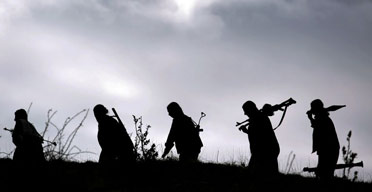
The party’s uniformed fighters, men and women, control checkpoints or patrol the roads and tracks that wind through the harsh, craggy terrain. The party has a sewing factory to make its uniforms, a clinic to treat its wounded and a cemetery to bury its dead.
 Shiho Fukada for The New York TimesRengin Ararat, 31, from Syria, blowing dust off her Kalashnikov assault rifle outside the sewing factory. She has been with the P.K.K. for 12 years.
A German doctor, Medya Avyan, now works at the hospital. She has no Kurdish roots, but volunteered to help the Kurdish cause after learning of it from friends in the 1990s. Her name is a Kurdish one she assumed after moving to northern Iraq in 1993. (She declined to give her original German name, saying only that she was from Celle in Lower Saxony and had studied medicine in Hamburg.)
On a bookshelf in behind her in the hospital was Mr. Ocalan’s photograph, a volume on Hippocrates and a history of the P.K.K. Asked how she reconciled treating people in a hospital operated by an organization accused of killing thousands, she replied with remarks that many in Turkey would dispute.
“The P.K.K. don’t kill any civilians,” she said. “That’s very important. They are killing those who kill them. They defend themselves, nothing else.”
All of the party’s members — its leaders, its fighters, its volunteers — defended their fight and their cause with a romanticism that makes it difficult to imagine their laying down arms and returning to peaceful civilian life. Many have been in the mountains for years.
 Shiho Fukada for The New York TimesThe P.K.K. movie crew, from left to right: Dersim Zerevan, 29, videographer; Jinda Baran, 32, director; and Zozan Agiro, 32, videographer. They have been shooting a film about P.K.K. couriers during the guerrilla struggle with Turkey.
“I have been a guerrilla for 18 years,” Gorse Mereto, 32, a uniformed fighter, said during a break in the improbable shooting of a propaganda film. (The set was a campfire at night, illuminated by stage lights hanging from trees.) “I have seen many difficulties. In all the situations in which I myself was present, no civilian was killed, but soldiers were.”
 Shiho Fukada for The New York TimesZozan Agiro, 32, a P.K.K. member and videographer. The P.K.K. movie was shot around the Qandil Mountains with P.K.K. actors, some of whom have fought in the campaign.
He had his own rationale, a history, viewed through Kurdish eyes, of Turkish oppression. It suggested a cycle of violence that would take time to break. “They have destroyed a lot of villages,” he said. “They have killed innocent civilians. They have killed many of our men.”
He continued, “Anybody, even an animal, defends itself.”
 Shiho Fukada for The New York TimesP.K.K. actors/guerrillas dancing in a scene from the movie, enacting celebrations around a campfire.
 Shiho Fukada for The New York TimesA P.K.K. actor taking part in the movie.
It is highly unlikely that Mr. Erdogan would consider autonomy for the Kurds, but analysts expect him to at least entertain notions like restructuring election laws to allow minority parties to have greater access to Parliament and allowing wider use of ethnic languages like Kurdish…
Publicly, the ruling party refuses to negotiate with the P.K.K., which is listed as a terror organization by the European Union and the United States. But behind the scenes, it has been reaching out to Kurdish activists to find common ground on which to build a viable solution.”