Παρασκευή 14 Οκτωβρίου 2011

Special operations forces hunt IMU's top commander in Afghan northeast


Afghan and Coalition special operations forces killed and captured dozens of insurgents during a raid that targeted the Islamic Movement of Uzbekistan's top leader in the north.
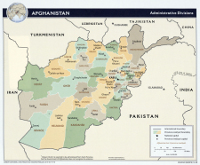
Map of Afghanistan's provinces. 
Click map to view larger 


The raid, which the International Security Assistance Force said was "led by more than 50 Afghan security members," took place in the Kishim district of the remote province of Badakhshan.

ISAF did not state how many insurgents were killed or captured, but the provincial spokesman for Badakhshan told Xinhua that 21 fighters were killed and nine more were captured. Two "group commanders" named Mullah Abadullah and Mullah Shir Mohammad were among those captured. "Roadside bomb making materials and multiple weapons were seized" during the raid, ISAF said in a press release.

The target of the raid was "northern Afghanistan's senior IMU leader, who facilitates suicide and roadside bomb attacks against Afghan security forces," ISAF stated. "The leader is a facilitator for IMU insurgents and senior leaders in Kabul and Ghazni, as well as, a coordinator for logistical and personnel movements for fighters throughout northern Afghanistan."

ISAF and Afghan forces captured the IMU's previous top commander in Afghanistan during a raid in Kunduz province in April 2011. He served as "a key conduit between the senior IMU leadership in Pakistan and senior Taliban leadership in Afghanistan," and aided in suicide, IED, and other attacks by the IMU in the north. He was freed from a Pakistani jail in 2010 and immediately returned to lead forces in Afghanistan [see LWJ report, ISAF captures Islamic Movement of Uzbekistan's top commander for Afghanistan].

Background on terrorist havens in the north

Earlier this year, ISAF identified several locations of safe havens and training camps in the north for the Taliban and the allied Islamic Movement of Uzbekistan. Both terror groups maintain a strong presence in the northern Afghan provinces of Badakhshan, Baghlan, Balkh, Faryab, Jawzjan, Kunduz, Samangan, Sar-i-Pul, and Takhar, and have established suicide and military training camps in the north over the past several years. As the two groups expand their presence in the region, top leaders of the Islamic Movement of Uzbekistan have integrated into the Taliban's shadow government in the northern provinces.

ISAF has identified the presence of suicide camps in Sar-i-Pul and Samangan provinces. On March 22, a special operations team captured an IMU commander who ran camps in Samangan. In addition, several other commanders who aid in suicide attacks have been targeted in the north.

The IMU has established camps in Kunduz province, a Taliban commander from Baghlan named Mustafa told the Asia Times earlier this year. The Taliban commander said that jihadis from Central Asia, including "Chechnya, Uzbekistan, Tajikistan, and Russia," make up a significant portion of the fighters in the the Afghan north and that they are setting their sights on the neighboring country of Uzbekistan.

"I can tell you that there is an active connection between the Central Asian command and the Taliban in northern Afghanistan and they often join us, but how they connect, this is beyond my level," Mustafa told Asia Times. "Our superior commanders are in touch with their counterparts in Central Asia and if somebody arrives in Afghanistan or goes to Central Asia from Afghanistan, it is arranged at a senior leadership level."

The Islamic Movement of Uzbekistan and the Islamic Jihad Group, an IMU splinter faction, are also known to operate in the southeastern Afghan provinces of Khost, Paktia, Paktika, Ghazni, and Zabul. The two groups work with the al Qaeda-linked Haqqani Network [see LWJ report, ISAF detains senior Haqqani Network leader linked to the IMU].

Background on the IMU in Pakistan

The IMU's leadership cadre is based in Pakistan's Taliban-controlled tribal agency of North Waziristan, and operates primarily along the Afghan-Pakistani border and in northern Afghanistan. According to one estimate, more than 3,000 Uzbeks and other Central Asian fighters are sheltering in North Waziristan.

The US ramped up airstrikes against the terror groups in North Waziristan between September 2010 and January 2011. Many of the strikes targeted cells run by the Islamic Jihad Group, which were plotting to conduct Mumbai-styled terror assaults in Europe. A Sept. 8 strike killed an IJG commander known as Qureshi, who specialized in training Germans to conduct attacks in their home country.

In South Waziristan, the IMU's former leader, Tahir Yuldashev, was killed in a US Predator airstrike in September 2009. Yuldashev sat on al Qaeda's top council, the Shura Majlis. He has been replaced by Abu Usman Adil.

Islamic Movement of Uzbekistan fighters often serve as bodyguards for top Pakistani Taliban and al Qaeda leaders. The IMU fights alongside the Taliban in Pakistan and Afghanistan, and has stepped up attacks in Central Asian countries as well.


Πηγή

Πέμπτη 13 Οκτωβρίου 2011

Brandenburger Special Forces in North Africa 1941


The Brandenburger[1] were a special forces unit of the German army, initially under control of the Abwehr[2], the German army’s secret service, and from 1943 slowly moving to normal control channels. They started out as a relatively small, highly specialist unit, and by the end of the war had grown to the size of a regular field division. By that time, they had become more like British Commandos, or US Rangers. They were very active in the Aegean, and participated in the reconquest of Kos and Leros in October 1943, Operation Eisbaer (Polar Bear), which is best described in Anthony Rogers’ excellent book Churchill’s Folly.
A very good and succinct description is available in German at this link. This includes a list of commanders, sub-ordinations, and other information, including a discussion of the role of the Brandenburgers in the context of the laws of war.
In the context of Operation CRUSADER, the Brandenburger played a small role. I have been able to piece much of it together by the use of ULTRA intercepts and with the help of posters on the Axis History Forum. They had been requested to support the planned attack on Tobruk, possibly by a seaborne landing. A relatively small force[3] was sent under Oberleutnant von Koehnen. This was from 13./Lehrregiment 800 Brandenburg z.b.V.[4], and had been sent directly from Catania in Italy by plane on 14/15 November. The remainder of this company stayed in Italy, and was ready to be moved at the request of the Panzergruppe, although there are indications that this was not going to be possible before February 1942, maybe due to the transport situation following the destruction of the Beta/Duisburg convoy on 8/9 November 1941. The strength of this detachment was likely 1 Officer, 11 non-commissioned officers, and 70 men.
It appears that this detachment was then rushed to Benghazi to shore up the defenses there, and maybe split up on the way, with part of it remaining in Agedabia under the command of an men called Doehring, maybe a senior non-commissioned officer. On 29 November, von Koehnen was in Benghazi with 1 officer, an unknown number of non-commissioned officers, and 31 men. The remainder of the company was at the time in Italy, with a strength of 3 officers, 31 non-commissioned officers, 159 men, and with 17 lorries, 8 cars, and 3 tractors.
It is possible that another company (11./LR 800) arrived in Benghazi as part of Sonderverband 288 (see this older post).
During the main battle these units seem not to have been engaged. They were basically immobile, and had little or no heavy weapons. It appears that they conducted an operation on 22 January 42 during the counter-offensive. My guess is this would have been a small operation, maybe using English-speaking soldiers wearing Commonwealth uniforms to confuse the Commonwealth forces by giving wrong traffic directions (always a favourite) or impersonating officers to give false orders.
[1] lit. ‘men from Brandenburg’, the region outside Berlin
[2] lit. avoid/defend
[3] A ‘Halbkompanie’, half company – not a formation existing anywhere else in the Wehrmacht to my knowledge.
[4]13th Company, Special Purpose Instruction Regiment 800

Τρίτη 11 Οκτωβρίου 2011

Anxiety Hovers Over Iraqi Commandos


BAGHDAD — A photographer and I recently embedded with an Army Special Forces unit that operates from a corner of Camp Victory, the United States military’s vast complex near the airport. Such embeds are extremely rare and this one took many months to secure — while the regular Army welcomes reporters with nearly unimpeded access, the Special Forces are leery of journalists. This was underscored by the long list of ground rules they require reporters to adhere to in order to protect operational secrecy.

One rule states, rather oddly, that photographers will not capture images of soldiers “with bearded faces.” Neither the public affairs officer, nor the cleanshaven Special Forces soldier standing by as we signed the document, could explain that one, except to speculate that it might be a remnant of the early days of the Afghanistan campaign, when commandos grew beards to fit in with the local population.

For the three days that the embed lasted, the soldiers kept a measured distance from their observers, always polite but guarded in their statements.

“We try to stay quiet professionals, low key,” said one Special Forces soldier, a chief warrant officer. (As part of the ground rules, the soldiers could be identified only by rank.)

Readily apparent were the stark differences in the culture the Green Berets have nurtured compared with the goofy bonhomie that pervades regular military units I have spent time with.

The soldiers here lived like vampires, sleeping all day and waking in the late afternoon. They wear civilian clothes until they gear up for missions at night, wearing the same black fatigues their Iraqi counterparts wear. Very few smoke, and they don’t salute their superiors. They aren’t required to wear hats outdoors.

Meanwhile, they carried on an easy camaraderie with the Iraqi unit that they train and plan and execute missions with. They don’t live together, but they do socialize in off hours. An American major said the Iraqis often stopped by their base to partake in soldierly customs: “lift weights; wear baseball caps; drink protein, Red Bulls.”

On an evening when there was no mission because many of the Iraqi soldiers were at a memorial service for a comrade killed in a car accident, a large group of Iraqis and Americans sat outside the barracks drinking tea and reflecting on the long war in which the American role is winding down.

These units have worked together since 2003, and so a certain anxiety about what comes next for Iraq — and for their relationships — hung over the conversation. In the early days, the Iraqis sometimes rode out on missions in commandeered bread trucks. Back then, classes of recruits would show up to training camp dressed in soccer uniforms because some political leaders had told them they would be trying out for the Iraqi national soccer team. (“They wanted to be on the Olympic soccer team and be a soldier,” recalled an American Special Forces sergeant.)

“Most of the people don’t want the Americans to leave,” said one Iraqi commander, offering his analysis of public opinion here.

His worry is that the country’s political class is keeping sectarianism alive, and using the regular Iraqi military to do so. “The average people can live together peacefully,” he said. The Iraqi Army, he said, “is not helping Iraq in the security situation.”

He had harsh words for Moktada al-Sadr, the anti-American cleric who has threatened renewed violence in the country if an element of American forces stays behind this year to keep training Iraqi security forces. He noted that Mr. Sadr had spent years in Iran, and used an expletive to describe the cleric’s role in Iraq.

He said Mr. Sadr’s Mahdi Army is “full of cowards” who “don’t have the guts to fight.”

There were lighter touches to the conversation, as one Iraqi soldier recalled learning American culture by watching the Oprah Winfrey Show with an American captain four years ago in Nasiriyah.

The next morning the Americans set up targets — one was a cardboard cutout of Saddam Hussein — for an indoor shooting exercise. “Identify the threat, and if he doesn’t have a weapon, we don’t shoot him,” one of the American advisers barked at the group of Iraqi soldiers. “Just like when we go on mission. If the guy doesn’t have a weapon, we don’t shoot him.”

That night, on a mission in a neighborhood not far from the airport, the Americans watched as the Iraqis secured and searched a building they believed to be a hide-out for two members of Al Qaeda in Iraq. No weapons were fired, and the bad guys nowhere to be found, just a big family woken up in the middle of the night.

The Americans will leave soon, but the fighting will continue.

“These people are fighting a war in their own country,” said one of the soon-to-depart Americans.

Δευτέρα 10 Οκτωβρίου 2011

US moves toward Afghan guerrilla war

By Brian M Downing


The United States is beginning an interesting new dimension to the 10-year-old war in Afghanistan. Counter-insurgency efforts will be complemented by an expanded unconventional warfare campaign in many insurgent-controlled areas. This change in approach may have a considerable impact on the stalemate and hasten meaningful negotiations. 


The US is training scores of special forces teams to infiltrate into and operate in areas that the Taliban and other insurgent forces have gained control of in the past few years. Such operations have been in effect for a few years now, but the program is enjoying greater support. Many recently retired special forces personnel are being asked to return to active duty - a sign that the program is significant and growing. 

The teams will be inserted into insurgent-dominated districts, chiefly in the south and east, and charged with conducting reconnaissance, interdicting the movement of men and materiel, directing air strikes, killing political and military leaders, and otherwise wreaking havoc in the insurgents' base areas. 

The teams will likely be accompanied by Pashtun scouts from the particular districts who will provide knowledge of the terrain, mountain trails, hiding places, and local notables - friendly or not. Some of these scouts will be defectors whose loyalties will have been thoroughly looked into, though suspicions will remain. This aspect of the effort parallels the Chieu Hoi program of the Vietnam War, which placed Vietcong defectors with US troops conducting operations in tough areas. 

It is hoped that the scouts, in conjunction with special forces teams, may in some districts be able to form local guerrilla bands to further weaken Taliban control - an insurgency within an insurgency. Even when the Taliban ruled most of Afghanistan (1996-2001), there were regions that resisted them and even formed insurgent bands to fight them. Today, many local tribes dislike the Taliban but acquiesce to them owing to intimidation or to the perception of their inevitable ascendancy. The identities of such tribes are reasonably known in Kabul and will be likely areas of concentration. 

Efforts to build anti-Taliban insurgencies will draw from 1990s programs that lured mujahideen fighters to the government side after the withdrawal of Soviet troops from certain provinces. The Afghan social group (qawm) was useful in attracting defectors as one member on the government side used social ties to attract other members of his qawm. 

The program seeks to further reduce the insurgents' momentum, throw their logistics and base areas into disarray, force them to withdraw prime troops from contested districts, and in time, bring the insurgents to a negotiated settlement. 

Across the Durand Line? 

Special forces teams might be used in cross-border operations into Pakistan, especially into the North Waziristan tribal area where the Haqqani network, al-Qaeda and kindred groups enjoy safe havens. Another prospective area would be in the northern part of Pakistan's Balochistan province, which is another insurgent base area and only 150 kilometers from the reasonably secure towns of Kandahar and Lashkar Gah. 

United States special forces personnel have trained Pakistani militias along the frontier and so already have knowledge of the terrain and the troops operating there. Furthermore, the US has built its own intelligence network inside Pakistan, which has been successful in targeting leaders of the Haqqani network and most notably in finding and killing Osama bin Laden. 

This intelligence network greatly irritated the Pakistani army and Inter-Services Intelligence service (ISI), and cross-border operations by US special forces will only increase the irritation. The US must be prepared for this. Only a few months ago, a cross-border incident led to a crisis in US-Pakistani relations, the constriction of US/International Security Assistance Force (ISAF) supply convoys, and eventually to an apology from General David Petraeus, then the US's top man in Afghanistan. 

Since then, however, events have put the Pakistani army and ISI on the back foot. The discovery of Bin Laden living comfortably near an army base, increased revelations of ties with various militant groups, and most recently suspected complicity in the murder of Syed Saleem Shahzad, Asia Times Online's Pakistan bureau chief, have cast a harsh light on a darker part of Pakistan. 

Many countries are looking on Pakistan as a rogue state - and a failing one. Nonetheless, stepped-up cross border activity may bring not only increased tension between the US and Pakistan, but also firefights between their troops. 

Prospects

Guerrilla operations and the smaller troop levels they require will allow the US to rely less heavily on supply routes winding through Pakistan - a country whose military is now deemed unreliable. A lighter logistical load can be increasingly borne by northern routes from Russia - a country whose commitment to containing Islamist militancy is now deemed quite reliable. 

The US has already reduced its reliance on Pakistan for logistics. A year ago, the preponderance of US/ISAF supplies came through Pakistan, but today only 40% do so, and that number is slated to dwindle to 25% by the end of 2011. Pakistan is becoming less important to the US. 

Special forces operations will reduce the need for massive firepower, which has long been a source of irritation in the Afghan people and a recruitment attraction for insurgent groups. Heavy fire power will be confined to extracting a beleaguered team or on identifying a sizable insurgent force. 

Guerrilla warfare could well allow the US to increase its effectiveness against the insurgents while at the same time reducing its troops levels and expenditures. Both will be welcome in the increasingly restive US public. Unconventional warfare might even intrigue the public, which retains considerable attraction for imaginative forms of war, resonant as they are with romantic figures such as T E Lawrence and less illustrious green berets of the Vietnam War. 

President Barack Obama's reduction of troop levels will almost certainly require consolidation into a number of enclaves in the south and east where counter-insurgency operations have met with success and some Pashtun tribes remain hostile to the Taliban. This will in effect cede more territory to the insurgents, but paradoxically this will have advantages. The more territory ceded to insurgent groups, the more territory they must defend from US guerrilla forces. 

Many observers will wonder why such unconventional warfare hasn't already been more widely put into effect. After all, the Taliban have controlled large parts of the south and east for a few years now and the US has long had a number of troops capable of such ops. Indeed, one of the principal missions of the green berets during the cold war was to organize insurgencies behind Soviet lines in the event Western Europe were to fall to the the Red army. 

Unfortunately, bureaucratic inertia and doctrinal commitment to conventional warfare won out, until recently. Many might even wonder if such operations would have been a more effective response to the September 11, 2001, attacks than overthrowing the Taliban and occupying a country so fragmented and fractious. But wisdom comes only late in the day. 

Brian M Downing served with indigenous forces during the Vietnam War and is the author of The Military Revolution and Political Change and The Paths of Glory: War and Social Change in America from the Great War to Vietnam. He can be reached atbrianmdowning@gmail.com. 


Κυριακή 9 Οκτωβρίου 2011

Green Berets Take Physical Training to the Beach

FORT WALTON BEACH, FL – It's safe to say most people go to the beach to soak up the sun and relax. However, the men of Bravo Company, 1st Battalion, 7th Special Forces Group (Airborne), aren't most people. The Green Berets tested their endurance and mental toughness with a multi-event endurance race at Fort Walton Beach, Fla., July 18, which pushed these Soldiers to their physical limits.
"Special Forces membership requires, at times, almost super-human physical abilities that must be maintained by all members of the organization," said Sgt. Maj. William Sarnosky, the B. Co. sergeant major.
Prior to the race the company divided itself into four teams. Each team assembled a canopy, under which they stored the equipment needed to compete and complete the endurance events.
The contest began with each Soldier completing as many sit-ups and push-ups as they could within a two-minute time limit.
Once complete the individual team members then tethered themselves to each other in preparation for the 1,000 meter swim event.  Once set, the four teams then lined up side-by-side on the beach facing the Gulf of Mexico to start the race.
At the sound of a blow horn, the teams rushed into the water racing out approximately 25 meters to a marked buoy where they turned and swam parallel the beach for 500 meters to the turnaround buoy and back to the start point. 
Once a team completed the swim, they exited the water and donned their boots for the next part of the race, a 1,000 meter litter carry.  In this event the team members were required to carry one team mate on a stretcher 500 meters down the beach to a marked turnaround point and return.
Immediately following the litter carry the teams set out on a two-mile beach run with the requirement for each team member to wear his individual body armor weighing roughly 40 pounds.   
"Events like this allow each member of the organization to size up his brother-in-arms and identify strengths and weaknesses at all levels which translates to bragging rights at home and survival on the battlefield, " said Sarnosky. "Additionally, these carnivores enjoy pushing themselves to their limits for the sweet taste of victory!"
After the grueling two-mile run the exhausted Soldiers administered IVs to each other to rehydrate, bringing the training event to an end.
"Training near the community gives our neighbors a small, however, better understanding of who the Green Berets really are."
Following the competition the Bravo Company men walked a half-mile long stretch of beach, picking up trash along the way.
"The idea of the police call was to demonstrate to the community that not only will we clean up after ourselves, but we care about the entire area that we now call home," said Sarnosky.

Σάββατο 8 Οκτωβρίου 2011

US Army adopts new breed of robotic battle vehicles


Created by Lockheed Martin, the Squad Mission Support System (SMSS) is “the largest autonomous vehicle to ever be deployed with infantry,” said Lockheed in announcement released today.


The Lockheed Martin SMSS leverages robotic technologies for unmanned transport and logistical support for light, early entry and special operations forces. It solves capability gaps by lightening the Soldier’s load and serving as a power management resource.

The SMSS will decrease the amount of time a Warfighter has to spend in controlling robotic systems by providing vehicles that can navigate autonomously. The SMSS’ supervised autonomy will provide the Warfighter with a reliable squad-size vehicle which will improve combat readiness, while assuring re-supply channels and casualty evacuations.

Combining perception with extraordinary mobility allows vehicles to follow the Warfighter across most terrain, guaranteeing the payload the robotic system is carrying will be available whenever and wherever the Warfighter needs it. Few other robotic systems allow for autonomy dependable enough for a vehicle to follow someone without the use of location-disclosing beacons. The vehicle can also operate by remote control, tele-operation or by manual control.

User-proven autonomy
SMSS is executing a contract for the U.S. Army to provide the SMSS as a portable power solution complementing the NettWarrior Soldier technology package. SMSS provided self-sustaining portable power, Soldier battery recharge and logistics support for infantry during user testing in November, 2010.

The system’s dependable autonomous technology has garnered three safety releases by the U.S. Army to work in close proximity around Soldiers. SMSS continues to log hundreds of hours with Army users as the system matures and is prepared for deployment:
Army Expeditionary Warrior Experiment, Spiral E, 2008
Military Utility Assessment, Fort Benning, 2009
Limited User Test – Portable Power, Ft. Riley, 2010
Army Expeditionary Warrior Experiment, Spiral G, 2011
Military Utility Assessment, Afghanistan, 2011 (anticipated)

Unmanned capabilities
The long-term vision of this system can accommodate armed variants, while improving its reconnaissance, surveillance and target acquisition capabilities within the concept of supervised autonomy. A squad-size manned or unmanned support vehicle is critical to today’s asymmetrical and urban battlefields.

Lockheed Martin’s experience in unmanned systems is unmatched with proven capabilities across all domains including air, land, sea and space. An integrated systems-of-systems approach allows Lockheed Martin to meet the challenges of network-centric warfare where both manned and unmanned technologies work collaboratively, increasing the affordability of the technology, the efficiency of the total force and ultimately, the success of their missions.