Osama bin Laden, the founder of the al-Qaeda organization responsible for the September 11 attacks in the United States, was killed by gunshot wounds to his head and chest on May 2, 2011, around 01:00 Pakistan Standard Time, in a 40-minute raid by United States special operations forces. The raid, code name Operation Neptune Spearalso known as the Abbotabad Operation, took place at his safe house in Bilal Town, Abbottābad, Pakistan. At the conclusion of the raid, U.S. forces took bin Laden's body to Afghanistan for identification before burying it at sea within 24 hours of his death.
The operation was authorized byPresident Barack Obama and carried out by members of the United States Navy SEALs from the Naval Special Warfare Development Group (DEVGRU), informally referred to by its former name, SEAL Team Six, under the command of the Joint Special Operations Command, in conjunction with U.S. Central Intelligence Agency (CIA) operatives. The team was sent across the border of Afghanistan to launch the attack.
The killing of bin Laden received a favorable response in the United States and was welcomed by Ban Ki-moon, Secretary-General of the United Nations, NATO, the European Union, and a large number of countries as a positive and significant turning point for global security and the War on Terror. The Palestinian Hamas leader of the Gaza strip, Ismail Haniya, however, said: "We condemn the assassination of a Muslim and Arab warrior".
The Pakistani government was criticized for failing to apprehend bin Laden, who had been living in a large prominent compound in a major Pakistani city, close to Pakistan's premier military academy and 30 miles from the capital, Islamabad. Pakistani officials denied knowingly harboring bin Laden, saying that they had no knowledge that he was there, and strongly denied allegations of official support for him.
Locating Bin Laden
American intelligence officials discovered the whereabouts of Osama bin Laden by tracking one of his couriers, as bin Laden was believed to have concealed his whereabouts from al-Qaeda foot soldiers or top commanders.
Identification of al-Qaeda couriers was an early priority for interrogators at CIA black sites and Guantanamo Bay detention camp.
By 2002 interrogators had heard uncorroborated claims about an al-Qaeda courier with the nom de guerreAbu Ahmed al-Kuwaiti (sometimes referred to as Sheikh Abu Ahmed of Kuwait). In 2003 Khalid Sheik Mohammed, the alleged operational chief of al-Qaeda, revealed under interrogation that he was acquainted with al-Kuwaiti but that he was not active in al-Qaeda.
In 2004 an al-Qaeda prisoner named Hassan Ghul told interrogators that al-Kuwaiti was close to bin Laden as well as Khalid Sheik Mohammed and Mohammed's successor Abu Faraj al-Libi. Ghul further revealed that al-Kuwaiti had not been seen in some time, a fact which led U.S. officials to suspect he was travelling with bin Laden. When confronted with Ghul's account, Khalid Sheik Mohammed stuck to his original story. Abu Faraj al-Libi was captured in 2005 and told CIA interrogators that bin Laden's courier was a man named Maulawi Abd al-Khaliq Jan. Al-Libi was transferred to Guantánamo in September 2006. He denied knowing al-Kuwaiti. Because both Mohammed and al-Libi had minimized al-Kuwaiti's importance, officials speculated that he was part of bin Laden's inner circle.
In 2007 officials learned al-Kuwait's real name, though they will not disclose the name nor how they learned it. The CIA never found anyone named Maulawi Jan and believes al-Libi made it up. In 2010 a wiretap of another suspect picked up a conversation with al-Kuwaiti. CIA officials located al-Kuwaiti and followed him back to bin Laden's compound. Al-Kuwaiti and his brother were killed along with bin Laden in the May 2, 2011 raid.
Since the name Maulawi Abd al-Khaliq Jan appears in the JTF-GTMO detainee assessment for Abu Faraj al-Libi released by WikiLeaks on April 24, 2011, there has been speculation that the US assault on the Abbottābad compound was expedited as a precaution.
Locating the Compound
A telephone conversation between al-Kuwaiti and another operative monitored by the CIA led the agency in August 2010 to track al-Kuwaiti to the compound in Abbottābad. Using satellite photos and intelligence reports, the CIA determined the identities of the inhabitants of the mansion to which the courier was traveling. In September, the CIA concluded that the compound was "custom-built to hide someone of significance", and that bin Laden's residence there was very likely. Officials surmised that he was living there with his youngest wife.
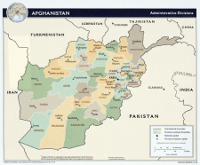
Built in 2005, the three-story compound was located "at the end of a narrow dirt road", 2.5 miles (4 km) northeast of the city center of Abbottābad. Abbottābad is about 100 miles from the Afghanistan border on the far eastern side of Pakistan (about 20 miles from India). The compound is 0.8 miles (1.3 km) southwest of the Pakistan Military Academy (PMA), Pakistan's "West Point". On a plot of land eight times larger than those of nearby houses, it was surrounded by 12-to-18-foot (3.7–5.5 m)concrete walls topped with barbed wire. There were two security gates, and the third-floor balcony had a seven-foot-high (2.1 m) privacy wall (which could hide the 6' 4" [1.93 m] bin Laden).
There was no Internet or telephone service connected to the compound. Its residents burned their trash, unlike their neighbors, who set their garbage out for collection. Local residents called the building theWaziristan Haveli (haveli is a term used in India and Pakistan that roughly translates to mansion) and believed it to be owned by a transporter from Waziristan, or possibly a gold merchant. Bin Laden had previously spent time in the Waziristan area of Afghanistan. Google Earth maps show that the compound was not present in 2001, but did exist on images taken in 2005.
The U.S. National Counterterrorism Center, using drone-derived intelligence, developed "what amounted to a detailed four-dimensional 'map' of the bin Laden compound and its occupants and their patterns of living and working." This map was used to create a model of the compound for practice runs.
CIA director Leon Panetta issued a memo that also credited the National Security Agency and National Geospatial-Intelligence Agency for contributing to the intelligence-gathering that made the raid possible. TheNational Journal reported that "NSA figured out, somehow, that there was no telephone or Internet service in the compound."
Operation Neptune Spear
After an intelligence-gathering effort on the courier's Pakistan compound that began September 2010, Obama met with his national security advisers on March 14 to create an action plan. They met four more times (March 29, April 12, April 19 and April 28) in the six weeks before the raid, including once on March 29, 2011 when Obama personally discussed the plan with Vice Admiral William H. McRaven, the commander of the U.S. Joint Special Operations Command. "Many multiple possible courses of action" were presented to Obama in March and "refined over the course of the next several weeks."
According to ABC News, the first approach considered by U.S. officials was to bomb the house using B-2 Spirit stealth bombers, which could drop 32 2,000-pound Joint Direct Attack Munitions (JDAMs). Obama rejected this option, opting for a raid that would provide definitive proof that bin Laden was inside, and limit civilian casualties. Another one of the "courses of action" (COA) suggested by JSOC was "a joint raid with Pakistani intelligence operatives who would be told about the mission hours before the launch." Deploying drones was apparently not a feasible approach, in part because of limited firepower and in part because the compound's location was "within the Pakistan air defense intercept zone for the national capital."
Members of the Naval Special Warfare Development Group began training for the raid (the objective of which remained unknown to them) after the March 22 national security meeting, "holding dry runs at training facilities on both American coasts, which were made up to resemble the compound." As plans progressed through the month of April, the DEVGRU SEALs began more specific training exercises on a one-acre replica of the "Waziristan Mansion" compound built at Camp Alpha, a restricted section of the Bagram military base in Afghanistan., practicing rappelling down into it from helicopters, among other tactical approaches. According to The Daily Telegraph, 24 Navy SEALs carried out practice runs on April 7 and April 13.
White House counterterrorism advisor John O. Brennan stated after the raid that "If we had the opportunity to take bin Laden alive, if he didn't present any threat, the individuals involved were able and prepared to do that." However, another U.S. national security official, who was not named, told Reuters that "'This was a kill operation,' making clear there was no desire to try to capture bin Laden alive in Pakistan." Another source referencing a kill (rather than capture order) states, "Officials described the reaction of the special operators when they were told a number of weeks ago that they had been chosen to train for the mission. 'They were told, "We think we found Osama bin Laden, and your job is to kill him,"' an official recalled. The SEALs started to cheer."
On April 29, at 8:20 am, Obama convened with Brennan, Thomas E. Donilon, and other national security advisers in the Diplomatic Reception Room and gave the final order to raid the Abbottābad compound. A senior administration official told reporters after the operation was completed that the government of Pakistan had not been informed of the operation in advance.
The raid planned for that day was postponed until the following day due to cloudy weather.
After President Obama authorized the mission to kill or capture Osama bin Laden, CIA Director Leon Panetta gave the go-ahead at midday on May 1.
The raid was carried out by 20 to 25 helicopter-borne United States Navy SEALs from the United States Naval Special Warfare Development Group (DEVGRU) of the Joint Special Operations Command, temporarily transferred to the control of the Central Intelligence Agency. According to The New York Times, "79 commandos and a dog were involved." Additional personnel on the mission included "tactical signals, intelligence collectors, and navigators using highly classified hyperspectral imagers."
The SEALs flew into Pakistan from Jalalabad, Afghanistan. (Previous reports indicated that they may have staged through Tarbela Ghazi Airbase in northwest Pakistan, but Pakistan has denied that the U.S. used a location in Pakistan to launch the raid.) The 160th Special Operations Aviation Regiment (SOAR), an airborne unit of the United States Army Special Operations Command sometimes called the "Nighthawks," provided two modified Black Hawk helicopters, and two Chinooks as backups. The 160th SOAR helicopters were supported by multiple other aircraft, including fixed-wing fighter jets and drones. According to CNN, "The Air Force also had a full team of combat search-and-rescue helicopters available."
The raid was scheduled for a time with little moon luminosity so the helicopters could enter Pakistan "low to the ground and undetected," and the helicopters used hilly terrain and nap-of-the-earth techniques to reach the compound without appearing on radar and alerting the Pakistani military. Once the raid began, the Pakistani military scrambled their fighter jets but did not interfere with the raid. According to Public Multimedia, Pakistan was informed by the U.S. about the raid once it had started, but was asked to stay out of the way.
The DEVGRU operators fast-roped out of the Blackhawks. After the operators were on the ground, one of the hovering helicopters stalled, in a vortex created by its own prop wash and the high compound walls, and "rolled onto its side" during an emergency landing outside the compound.
At approximately 1:00 a.m. local time (20:00, May 1 UTC), the SEALs breached the compound's walls using explosives and attacked the compound's structures as the compound's occupants opened fire.
The SEALs neutralized the guards, who may have consisted of only the courier and his brother, and then cleared the various structures in compound, including the main building, room-to-room. CNN Fighting took place in the main building on the first floor, where two adult males lived, and on the second and third floors, where bin Laden lived with his family. The second and third floors were the last section of the compound to be cleared. Personnel in the compound encountered and captured by the SEALs, including women and children, were restrained with plastic zip ties and left in place until the raid was over, at which point the SEALs moved them all outside. reported there were no armed guards around the compound and the couriers were killed on the first floor of the compou
Bin Laden and the DEVGRU team encountered each other on the third floor of the residence; bin Laden was "wearing the local loose-fitting tunic and pants known as a shalwar kameez." "The encounter with bin Laden lasted only seconds," according to Politico, and took place during "the last five or 10 minutes" of the raid.According to U.S. officials, Bin Laden resisted the American special operation team. He was unarmed when he was shot Bin Laden was killed by at least one and possibly two American bullets, one of which struck the left side of his head. (The second shot was either a second bullet to the head, or to the chest.)
Three other men and a woman present at the compound were also reportedly killed in the operation, including bin Laden's adult son, the courier, the courier's brother, and the courier's wife. Two other women were injured. According to ABC News, bin Laden's wife was one of the injured women, "When the SEALs entered the room in which bin Laden was hiding, his wife charged them and was shot in the leg." It remains unclear which of bin Laden's adult sons was killed in the raid. The New York Times reported that U.S. authorities determined that the man was Hamza bin Laden. The Associated Press cited John O. Brennan as giving the man's identity as Khaled bin Laden. While bin Laden's body was taken by U.S. forces, the bodies of the four others killed in the raid were left behind at the compound. Pakistani television network GEO TVidentifies the son as Ibrahim bin Laden. Bin Laden's 12-year-old daughter also saw him killed.
The exact number and identity of the people living in the compound is uncertain. Several appear to be members of the Osama bin Laden family, including possibly his fourth wife and their daughter. A U.S. official told the Associated Press that in addition to the five adults who were killed during the operation, 23 children and 9 women were in the compound. The National Journal reported that 22 people were counted in the compound. A Pakistani official told the New York Times that nine children ranging from two to 12 years old were placed in Pakistani custody. According to the British Daily Mail, "four children and two women, including bin Laden's daughter Safia, were taken away in an ambulance."One other person was reportedly taken away alive by the U.S. military.
The raid was intended to take 30 minutes. All told, the time between the team's entry in and exit from the compound was 38 minutes. Time in the compound was split into exchanging gunfire with the defenders and searching the compound for information. U.S. personnel removed computer hard drives, documents, DVDs, thumb drives and "electronic equipment" from the compound for later analysis.
The helicopter that had made the emergency landing was damaged and could not fly the team out. It was consequently destroyed to safeguard its classified equipment; after they "moved the women and children to a secure area" U.S. forces "improvise[d] by packing the helicopter with explosives and blowing it up." The assault team "called in one of two backup [helicopters]" to ferry them back to their base.
Local Accounts of Raid
Details of the raid, albeit observed from a distance, were tweeted by Abbottābad resident Sohaib Athar, who initially did not know what was happening; he had begun tweeting by complaining about the unaccustomed noise of low-flying helicopters. Karachi's Geo News described a helicopter crash and "heavy firing" on the evening of May 1 "near the PMA Kakul Road".
The UK Telegraph quoted a resident of the area who said, "We saw four helicopters at around 2 am. We were told to switch off lights of our homes and stay inside."
According to BBC's Owen Bennett-Jones in Islamabad, reporting two days after the raid, ISI informed him after questioning survivors of the raid that there were 17 to 18 people in the compound at the time of the attack and that the Americans took away one person still alive, possibly a bin Laden son. The ISI also said that survivors included a wife, a daughter and eight to nine other children, not apparently bin Laden's; all subsequently had their hands tied.
Code Name
There were conflicting reports in the media regarding what the official mission code name was. Originally reported as "Operation Geronimo" it subsequently was reported as "Operation Neptune['s] Spear"; with "Geronimo" as the code name for bin Laden himself.
The name derives from Geronimo, the Native American leader of the Chiricahua Apache who defied the U.S. government and eluded capture. Unlike bin Laden, Geronimo was never killed by U.S. military forces.Channel 4 News said "According to some analyses today, the U.S. military chose the code name because bin Laden, like Geronimo, had evaded capture for years. If they were trying to avoid mythmaking, it seems they chose the wrong code name." Once bin Laden was killed, one of the commanders reported "Geronimo E-KIA", meaning that the mission had ended with the "Enemy Killed In Action."
Native Americans objected to the use of the name Geronimo. "It's how deeply embedded the 'Indian as enemy' is in the collective mind of America," said Suzan Shown Harjo, president of the Washington, D.C.-based Morning Star Institute, a Native American advocacy group. "There is little doubt [the] use of a leader like Geronimo to refer to bin Laden is ill-advised," wrote Keith Harper, an attorney and member of the Cherokee Nation, in an email with a reporter for the The Washington Post.